
What Happens When You Fall Into a Black Hole?
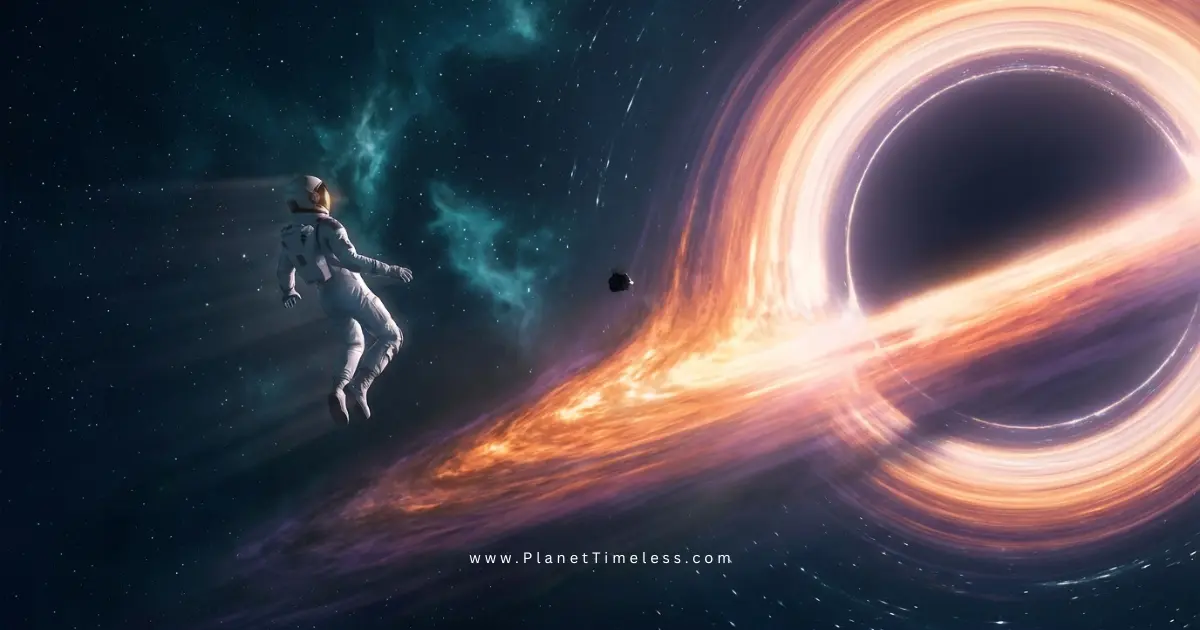
Imagine you’re falling feet-first toward the most violent object in the universe. Your feet — closer to the
black hole — get pulled harder than your head. The difference in gravity across your body isn’t subtle. It’s
enough to stretch you out, atom by atom, into a long thread of plasma. Scientists have a name for this:
spaghettification. And that’s just the opening act.
Black holes are the most extreme things that exist. They bend space, slow time, and crush matter into a
point of infinite density. Most of what people “know” about them comes from movies — and movies get
almost everything wrong except Interstellar.
So what does physics actually say? What would you experience? What would an outside observer see?
The answers are strange, counterintuitive, and genuinely mind-bending.
The Black Hole Itself — What You’re Actually Falling Into
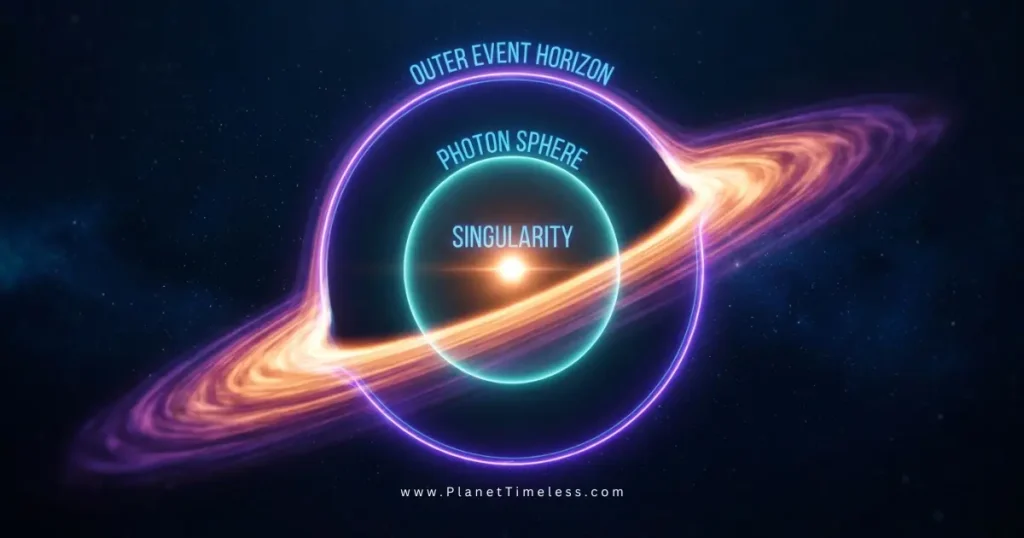
The Event Horizon: A Point of No Return
A black hole isn’t a giant cosmic vacuum cleaner with a visible mouth. It’s a region of space where gravity
is so strong that even light can’t escape. The boundary where escape becomes impossible is called the
event horizon. Cross it, and nothing — not light, not signals, not you — is coming back.
Think of it like a river with a current stronger than any boat’s engine. The moment your boat crosses the
threshold, the current overtakes you no matter how hard you paddle. The event horizon is that threshold.
The size of the event horizon depends on the black hole’s mass. For a stellar-mass black hole (a few times
the mass of our sun), it might be just a few kilometers across. For a supermassive black hole — like the
one at the center of our galaxy — it could be bigger than our entire solar system.
Size Matters More Than You’d Think
This is where it gets interesting. Smaller black holes are actually more dangerous to approach than bigger
ones.
The tidal forces — the stretching effect — depend on how quickly gravity changes across your body.
Near a small black hole, the gradient is steep: the difference in pull between your head and feet is
enormous even at relatively large distances. Near a supermassive black hole, that gradient is gentler, so
you could theoretically cross the event horizon without immediately being shredded.
Not that it helps you in the long run.
The Fall — What You Would Actually Experience
From Your Perspective
Here’s the strange part: if you were falling into a large enough black hole, you might not feel anything
dramatic as you cross the event horizon. No alarm bells. No visible wall. Just… you keep falling.
From your reference frame, you cross the boundary in finite time. Physics, as you experience it locally,
stays normal. You can still breathe, think, and check your watch. For a while.
As you get closer to the singularity — the point of infinite density at the center — the tidal forces grow
rapidly. Eventually, nothing can save you. Even the atoms of your body can’t hold their shape against the
gradient. The spaghettification that started gently becomes catastrophic.
dilation
From an Outside Observer’s Perspective
Now flip the camera. Watch someone fall from a safe distance, and you see something completely
different.
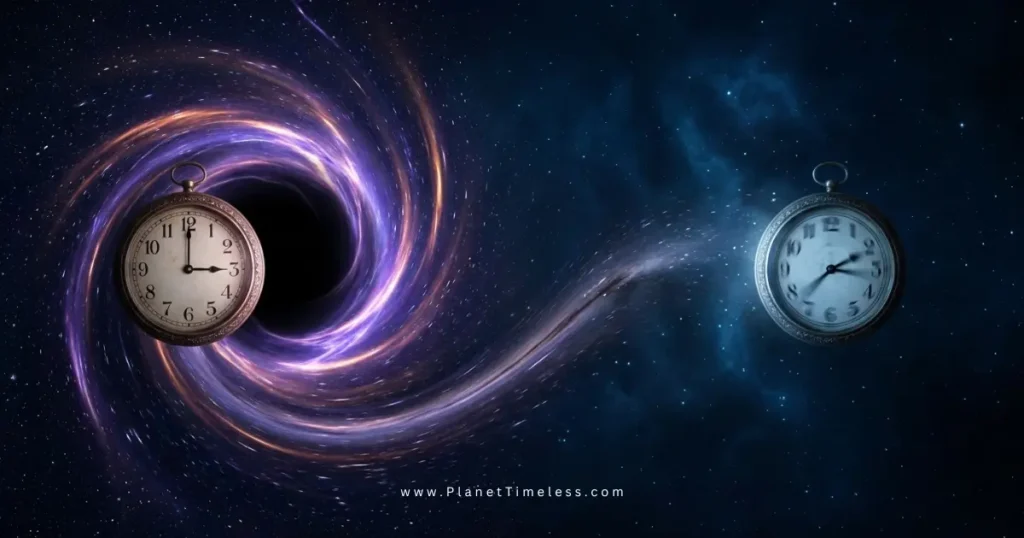
Because of gravitational time dilation — a real, measurable prediction of Einstein’s general relativity —
clocks near a massive object run slower relative to clocks far away. As your friend falls toward the event
horizon, you see their clock slow down. They move in slow motion. Their image gets redder and dimmer
as their light loses energy climbing out of the gravitational well.
They appear to freeze at the event horizon. From your view, they never actually cross it — they just fade
and stop, like a photograph that gets slowly overexposed into nothing.
Both of these descriptions are physically valid. That’s not a paradox — it’s a feature of how spacetime
works near extreme gravity. Two observers can have completely different (but both correct) experiences
of the same event.
Time, Light, and the Universe Speeding Up
If you’re the one falling and somehow had an indestructible telescope pointed backward at Earth, you’d
see something remarkable: the universe outside appears to speed up.
As time slows for you near the black hole, the light arriving from the outside universe is blueshifted and
arrives in rapid bursts. Stars appear to move faster. If you could survive long enough, you’d theoretically
watch billions of years of cosmic history flash by — stars being born and dying, galaxies colliding — all
in what feels like moments.
This is time dilation in its most extreme form. It’s not theoretical — GPS satellites have to correct for a
mild version of it every single day, because they’re slightly farther from Earth’s gravity and run
fractionally faster than clocks on the ground.
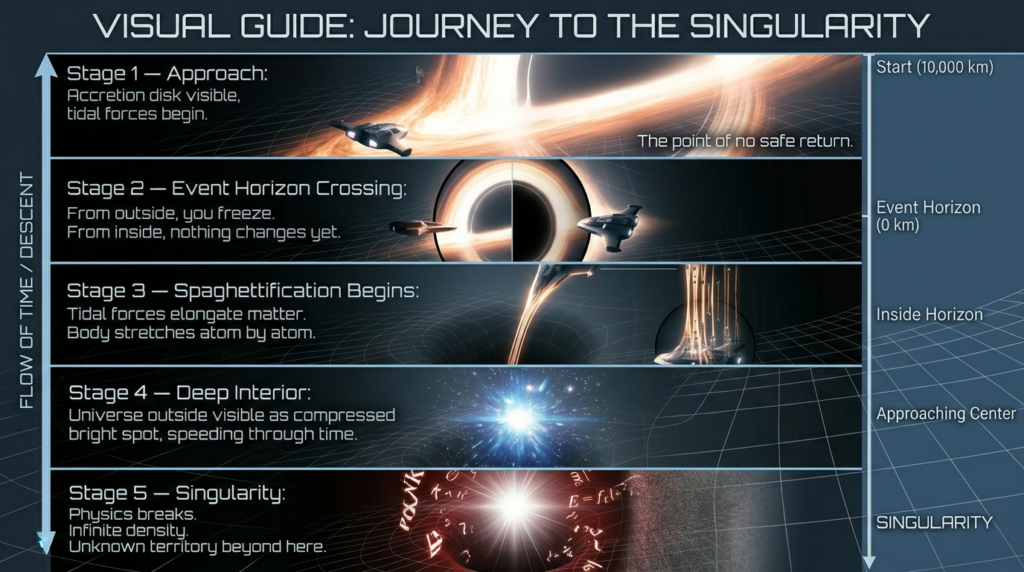
The singularity itself is where our physics breaks. General relativity predicts infinite density, infinite
curvature, a literal breakdown of the equations. Whether something more exotic — a quantum gravity
theory we haven’t completed — takes over there is one of the biggest open questions in all of physics.
What’s Actually On the Other Side?
Wormholes: More Fiction Than Fact (For Now)
Popular culture loves the idea that black holes are portals — gateways to other galaxies or universes. The
math of general relativity technically allows for solutions called Einstein-Rosen bridges (what we call
wormholes), but there’s no evidence they actually exist in nature.
Even theoretically, a wormhole would be incredibly unstable. It would collapse almost instantly and
would require exotic negative-energy matter to stay open — stuff we’ve never observed. The interstellar
travel version is almost certainly science fiction.
What Information Theory Says
There’s a deeper question physicists are still fighting over: does a black hole destroy information?
According to quantum mechanics, information can never be truly destroyed — it can be scrambled, but
the underlying data persists. But the original formulation of Hawking radiation (the slow evaporation of
black holes) suggested information was lost. This is the black hole information paradox, and it’s one of
the thorniest unsolved problems in theoretical physics.
The current leading idea, championed by Stephen Hawking and later refined by others, is that information
is somehow encoded in the radiation the black hole emits as it slowly evaporates. But the exact
mechanism is still debated.
Hawking Radiation: How Black Holes Die
In 1974, Stephen Hawking showed that black holes aren’t perfectly black. Due to quantum effects near the
event horizon, they emit a slow trickle of thermal radiation, now called Hawking radiation. Over
astronomically long timescales, this causes them to lose mass and eventually evaporate completely.
For a stellar-mass black hole, this process takes longer than the current age of the universe — many,
many times over. But it means black holes aren’t eternal. They have a lifespan. They die.
Frequently Asked Questions
Would you feel anything when you cross the event horizon?
For a small black hole, yes — the tidal forces would be immediately lethal before you even reach the
event horizon. For a large enough supermassive black hole, you might cross the event horizon without
feeling anything dramatic at all. Locally, physics stays normal right up until the tidal forces eventually
become overwhelming closer to the singularity.
Does time actually stop at a black hole?
Not for the person falling — they experience time normally from their own perspective. What appears to
stop, from an outside observer’s view, is the rate at which the falling person’s clock ticks. They appear to
freeze and fade at the event horizon due to extreme gravitational time dilation. But from the inside, time
keeps moving.
Can anything escape a black hole?
Nothing with mass or that travels at or below the speed of light can escape once past the event horizon —
including light itself. The only exception is Hawking radiation, a quantum effect at the boundary where
particle-antiparticle pairs form and one escapes. But this is a slow trickle of thermal radiation, not a
dramatic escape.
What happens at the singularity?
Honestly, we don’t know. General relativity predicts infinite density and infinite spacetime curvature — a
mathematical breakdown of the equations. Most physicists believe this means our current physics is
incomplete near the singularity, and a working theory of quantum gravity (which we don’t yet have) is
needed to describe what’s actually happening there.
Are black holes dangerous to Earth?
The nearest known black hole to Earth is over 1,000 light-years away. Black holes don’t roam around
eating things — they exert gravity just like any other massive object. If our Sun magically became a black
hole (it can’t, it’s not massive enough), Earth would just keep orbiting in the dark. The danger from a
black hole requires being close to one.
Closing
Black holes are where our understanding of reality starts to fray at the edges. They’re places where two of
our best theories — general relativity and quantum mechanics — still refuse to play nicely together. And
that tension is exactly why they remain one of the most studied objects in all of physics.
If this made your brain hurt in a good way, drop a comment below. What concept surprised you most?
And if you want to keep going down this particular cosmic rabbit hole, check out our deep-dive on how
time dilation works and why it matters beyond black holes.
Share this with someone whose mind needs expanding today.
Also Read this: Black Holes 101: What They Are, How They Form, and Why Scientists Are Obsessed