
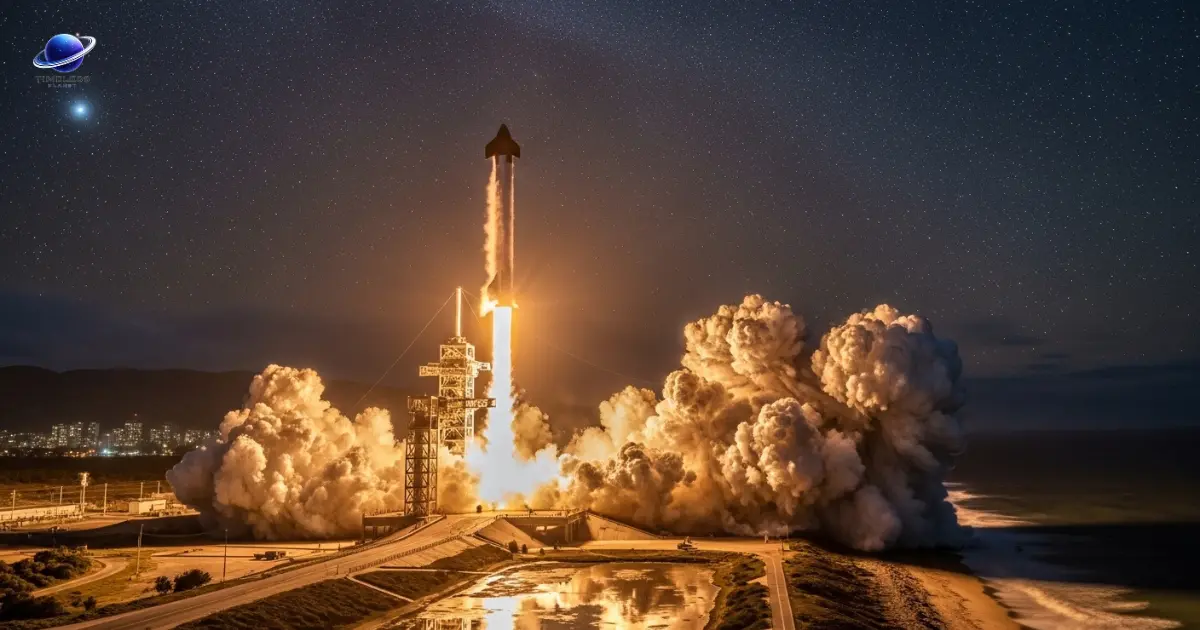
Starship Reusability Every Space Enthusiast ask this same question
Imagine building an airplane, flying it once across the Atlantic, and then throwing it into the ocean. You build a brand new one for every single flight. That is, almost unbelievably, how humanity has been launching rockets into space for more than six decades. SpaceX’s Starship is about to make that model extinct. And when it does, nothing about space exploration — or the economics behind it — will ever be the same again.
The Problem With Throwing Rockets Away
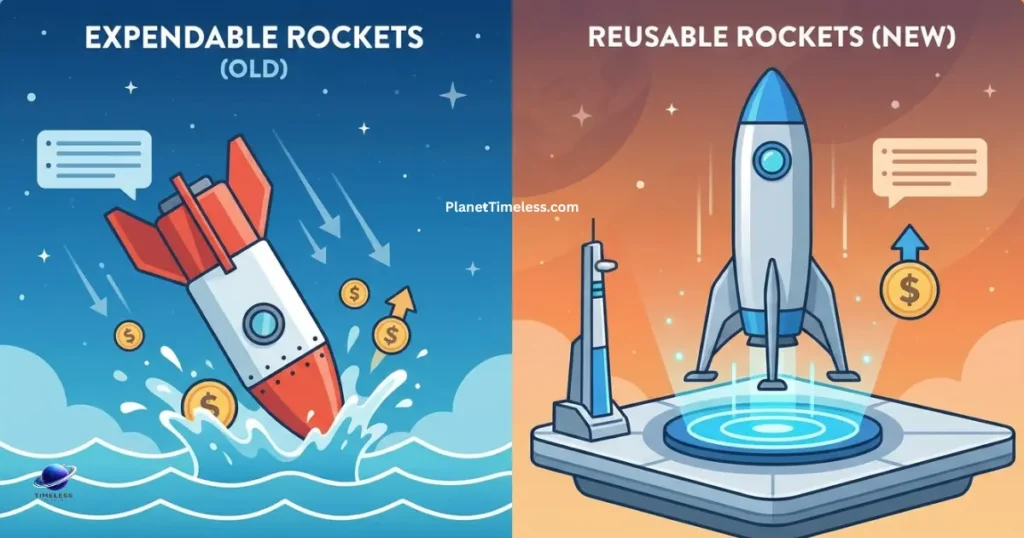
To understand why Starship matters so much, you first have to understand what came before it. Traditional rockets — from the Saturn V that carried Apollo astronauts to the Moon, all the way to the modern Atlas V — were built as one-use machines. Engineers spent months assembling them, technicians carefully checked every bolt and wire, and then, after a few minutes of fire and fury, the rocket was gone. Most of it fell into the ocean. What wasn’t lost burned up in the atmosphere. Every single launch meant building a brand new vehicle from scratch.
The cost this created was staggering. For decades, launch costs remained stubbornly high — roughly $10,000–$54,000 per kilogram to low Earth orbit — making space the exclusive domain of governments and the largest commercial operators. These were not prices that left room for experimentation, innovation, or accessibility. Space belonged to a handful of powerful nations and deep-pocketed corporations. Everyone else watched from the ground.
SpaceX changed the conversation with Falcon 9 — a rocket whose first stage could land itself back on Earth and be reflown. SpaceX achieved the first successful orbital-class booster landing in December 2015 and has since recovered and reflown Falcon 9 first stages over 300 times. The economics shifted almost immediately. But even Falcon 9 was only partially reusable. Its upper stage — the part that actually carries payloads to orbit — was still discarded after every flight. Starship changes that entirely.
$54K Cost per kg to orbit — Space Shuttle era ~$2,700
Cost per kg — Falcon 9 (partially reusable)
<$100 Projected cost per kg — Starship (fully reusable)
What Starship Actually Is
Starship is not just a big rocket. It is the largest and most powerful launch system ever built, and it is designed from the ground up to be used over and over again — like an aircraft. The vehicle consists of two main parts: the Super Heavy booster, a massive first stage powered by 33 Raptor engines, and the Starship upper stage, the sleek stainless steel ship that sits on top and actually carries passengers or cargo.
Together, they stand about 122 meters (400 feet) tall — taller than any rocket ever flown. And both stages are designed to return to Earth, land, refuel, and fly again. Both Starship’s first and second stages are planned to be reusable and are planned to be caught by the tower arms used to assemble the rocket at the pad. This is not a modest ambition. It is a complete reimagination of what a rocket can be.
The Mechazilla Moment That Changed History
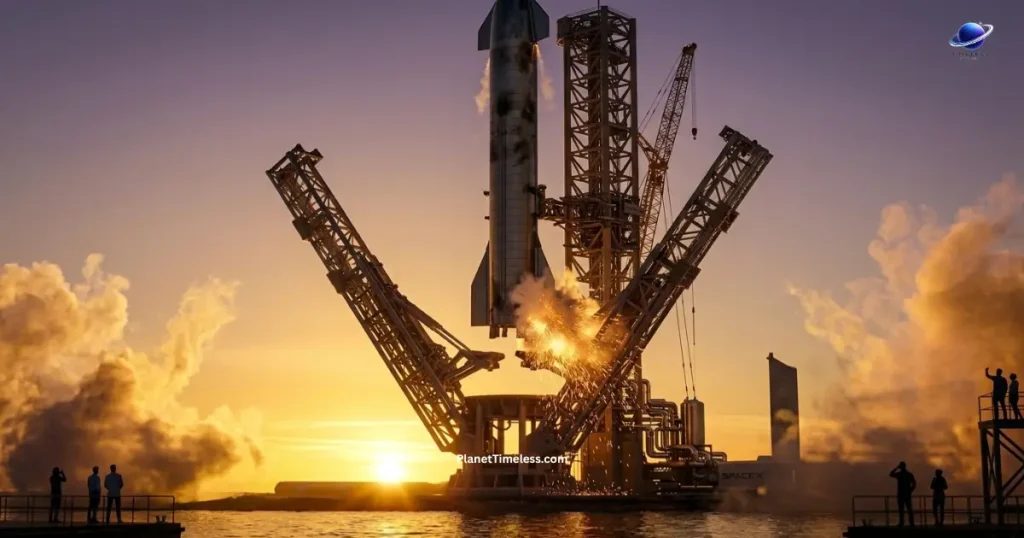
If you want a single image to understand what Starship represents, picture this: in October 2024, a 232-foot-tall rocket booster fell back through the atmosphere at incredible speed — and was caught in mid-air by two giant mechanical arms attached to the launch tower. No parachutes. No drone ships in the ocean. Just a precision-guided piece of engineering catching a multi-story rocket like it was a piece of origami.
The Super Heavy booster was successfully caught and recovered for the first time during Flight 5 with Booster 12 in October 2024, and the maneuver has since been repeated on subsequent flights including Flight 7 and Flight 8. The crowd watching the livestream erupted. Engineers wept. It looked like science fiction. It was real. And it proved, beyond doubt, that SpaceX’s approach to rocketry was not just ambitious — it worked.
“Catching a 230-foot booster out of the air with mechanical arms isn’t just impressive engineering. It’s the moment the economics of space travel shifted permanently.”
How Reusability Rewrites the Economics of Space
The financial implications of full reusability are almost hard to wrap your head around. Think about commercial aviation for a moment. A modern passenger jet might cost $200 million to build. But because it flies hundreds of routes before retirement, the cost per passenger becomes manageable. If airlines had to scrap every plane after a single flight, tickets would cost millions of dollars each. That has essentially been the reality of spaceflight — until now.
SpaceX’s Starship aims to be 100% reusable, taking launch costs to just $10 per kilogram — a game-changer that could make spaceflight as routine as air travel. To put that in perspective, launching one kilogram to orbit on the Space Shuttle cost over $54,000. With a fully reusable Starship, that same kilogram might cost less than a movie ticket at a premium cinema.
The consultancy Bain envisioned Starship reducing the cost per kilogram to low Earth orbit by 50 to 80 times, marking the commoditization of space launches and putting substantial pressure on other active launch providers. When costs drop by that magnitude, things that were previously impossible become obvious. Factories in orbit. Mining on the Moon. Point-to-point travel around Earth in under an hour. These stop being science fiction and start being business plans.
Turnaround Time: The Key Nobody Talks About
Cost per kilogram is only half the story. The other half is how quickly you can refly. Traditional expendable rockets require months to build, test, and prepare. In contrast, reusable rockets can be turned around in weeks — or even days — with minimal refurbishment. This means companies can serve more customers per year, scale operations efficiently, and keep investors confident with consistent revenue streams.
SpaceX’s ultimate vision for Starship involves flying it multiple times per day, similar to how commercial aircraft operate. The launch tower infrastructure, designed to catch and rapidly reload the booster, is a central part of that vision. Each flight that catches and reflies the booster without major refurbishment brings that vision one step closer to reality.
Why This Matters for Starlink and Satellites
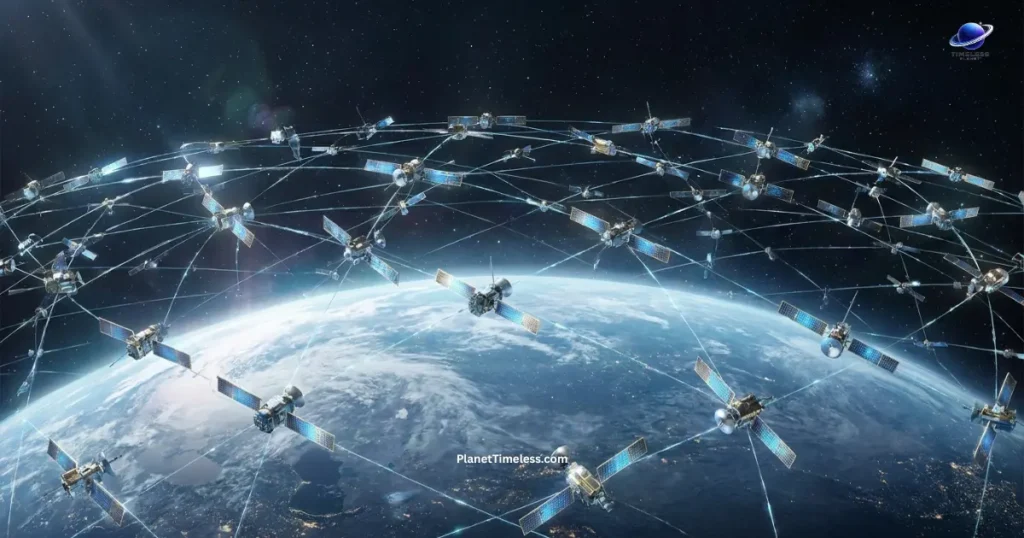
Mega-constellations like Starlink, with 9,850+ satellites, would have been economically impossible at 2010 launch prices. Starship is designed to carry 100–150 tonnes to low Earth orbit per flight, enabling mass deployment of next-generation satellites at costs that simply weren’t achievable before. Every major satellite operator in the world is watching Starship’s development very closely.
Flight Tests: The Road to Full Reusability
SpaceX has never claimed this would be easy, and the test flight record reflects that honestly. Starship has gone through multiple iterations, learning from each flight in ways that feel more like Silicon Valley software development than traditional aerospace. Early flights ended in explosions. Later ones achieved orbit. Each one taught engineers something new.
As of late 2025, SpaceX had completed 11 Starship flight tests, with 6 successes and 5 failures. The American company has developed Starship with the intention of lowering launch costs using economies of scale by reusing both rocket stages, increasing payload mass to orbit, and increasing launch frequency.
The heat shield — a critical piece of technology that protects the Starship upper stage during reentry — has been one of the most demanding engineering challenges. Thousands of hexagonal ceramic tiles cover the belly of the ship, each one protecting it from temperatures that would vaporize ordinary metals. SpaceX has been iterating on these tiles with every flight, testing new materials and configurations, including metallic tile options with active cooling systems.
As of late 2025, Starship vehicles use Raptor 2 engines, with Raptor 3 engines expected to first be used on Block 3 vehicles. Over 300 Raptor 3 engine tests have already been conducted with a cumulative duration of over 16,000 seconds. This relentless testing cadence is what separates SpaceX from traditional aerospace programs that might take a decade to move from prototype to production.
The Bigger Mission: NASA, the Moon, and Mars
Starship’s importance extends far beyond SpaceX’s own commercial ambitions. NASA has selected Starship as the Human Landing System for the Artemis program — the agency’s effort to return American astronauts to the Moon for the first time since 1972. This is not a minor footnote. Starship is the vehicle that will actually land on the lunar surface and carry astronauts from orbit down to the Moon’s south polar region.
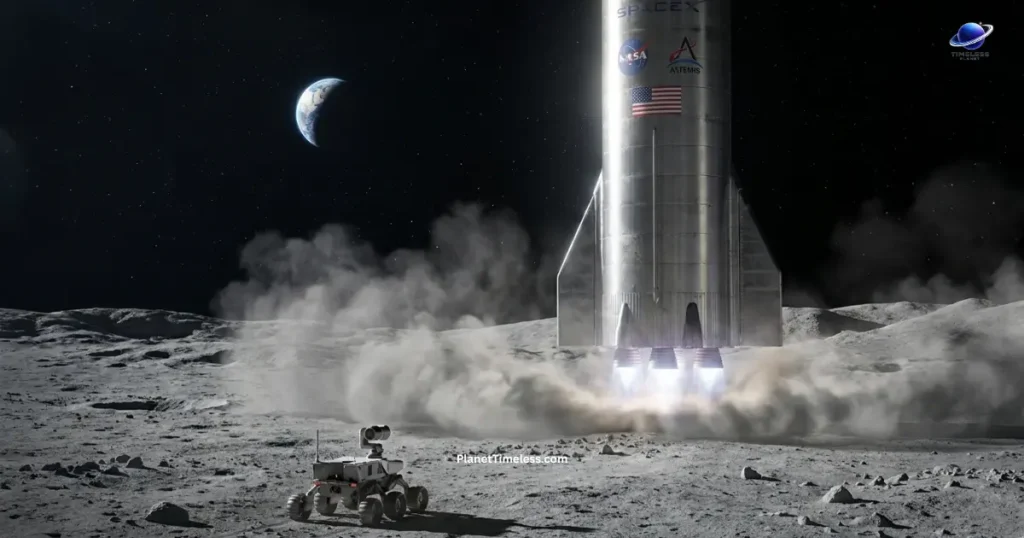
The current schedule calls for Starship to deliver NASA astronauts to the lunar south polar region during the Artemis 3 mission, targeted for late 2026 or 2027. To accomplish this, SpaceX will need to demonstrate propellant transfer between two Starships in orbit — a technically demanding operation that has never been attempted before. Success would unlock not just lunar missions, but eventually deep-space missions to Mars and beyond.
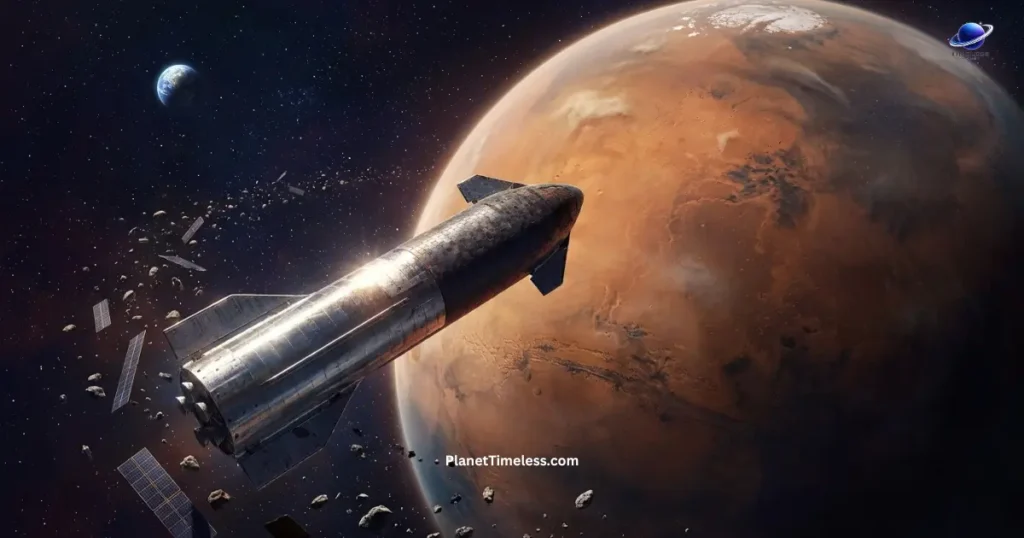
And then there is Mars. Elon Musk founded SpaceX in 2002 with the explicit goal of making humanity a multi-planetary species. Everything — Falcon 9, Crew Dragon, Falcon Heavy — has been a stepping stone toward that vision. Starship is the vehicle that actually gets humanity there. Musk has expressed high confidence in sending several uncrewed Starships to Mars within a few years, with crewed missions potentially following within a few years of successful uncrewed landings.
What Full Reusability Means for the Space Industry
When Starship achieves routine, rapid reusability, the ripple effects will be felt across the entire global space industry. Legacy launch providers — companies and governments who built their business models around expensive, single-use rockets — will face an existential reckoning. The economics that sustained them for decades will simply no longer apply.
A surge of interest in reusable launch vehicles is already sweeping the industry globally. In China, multiple companies are racing to launch reusable rockets before 2027. Blue Origin’s New Glenn has demonstrated booster recovery. Rocket Lab is developing the Neutron rocket to compete in this new market. The competitive pressure Starship is creating has accelerated innovation across the entire sector in ways that would not have happened otherwise.
There is also the environmental dimension. Reusable rockets generate far less debris and manufacturing waste than their expendable counterparts. Reducing the number of discarded rocket components lowers space debris, which is a growing issue, and has an environmental impact that aligns with the growing global emphasis on responsible and sustainable practices. In a time when the orbital environment around Earth is becoming increasingly crowded, this matters more than people realize.
Who Benefits Beyond Governments?
For most of spaceflight history, the only customers for rockets were governments and major telecommunications companies. The cost simply barred everyone else from entry. Full Starship reusability changes that calculus completely. Universities that could never afford a dedicated launch can suddenly consider putting research payloads into orbit. Startups working on in-space manufacturing, asteroid mining, or space tourism can build viable business cases. Even industries that seem entirely Earth-bound — agriculture, disaster response, global communications — stand to benefit from cheaper, faster access to orbit.
The space economy, which was valued at hundreds of billions of dollars before Starship’s development, is projected to grow into a multi-trillion dollar industry over the coming decades. A significant portion of that growth depends directly on whether launch costs continue to fall. Starship is the single biggest lever pushing those costs down.
Also Read: Artemis II: The Crew Making History Around the Moon (2026)
Frequently Asked Questions
-
What makes Starship different from other rockets?
Starship is the first rocket system designed for complete and rapid reuse of both stages — the Super Heavy booster and the Starship upper stage. Unlike Falcon 9, which reuses only its first stage, Starship is built to fly like an aircraft: land, refuel, and launch again, potentially on the same day.
-
How much will a Starship launch cost?
SpaceX is targeting a dramatic reduction in cost to orbit. While traditional rockets charge $10,000 or more per kilogram, a fully reusable Starship could potentially bring that below $100 per kilogram — and eventually as low as $10 per kilogram at high flight rates. That is a 1,000x improvement over historical norms.
-
Has SpaceX successfully caught the Super Heavy booster?
Yes. SpaceX first caught the Super Heavy booster using the mechanical “chopstick” arms of the Mechazilla launch tower during the fifth flight test in October 2024. This feat has since been repeated on subsequent flights, proving the concept is reliable and repeatable.
-
What missions is Starship being built for?
Starship is designed for an enormous range of missions: deploying Starlink’s next-generation satellites, carrying crew and cargo to the International Space Station, landing NASA astronauts on the Moon for Artemis, point-to-point hypersonic travel around Earth, and ultimately transporting humans and cargo to Mars.
-
When could Starship carry humans?
Starship is currently targeting its first crewed lunar landing with NASA as part of the Artemis program in 2026 or 2027. Commercial crewed missions and Mars-bound flights are expected to follow in subsequent years, depending on the pace of hardware development and regulatory approvals.
-
How does Starship’s heat shield work?
The Starship upper stage is covered in thousands of hexagonal ceramic heat shield tiles that protect it from the extreme temperatures of reentry. SpaceX has been continuously improving this system across flights, testing new materials including metallic tiles with active cooling to find the most durable and lightweight solution for rapid reuse.
The Frontier Is Opening
Starship represents something rare in the history of technology: a genuine step-change, not a gradual improvement. When rockets become reusable at scale, the economics of space flip entirely. The missions that seemed impossible become obvious. The companies that couldn’t afford to exist get to launch. The planets that seemed forever out of reach start looking like destinations. We are at the beginning of that shift — and the most exciting part is that we are only just getting started.
1 thought on “Starship Reusability: The Ultimate Game-Changer in Space”