
How Quantum Computers Works.
Picture a combination lock with a billion possible codes. A regular computer tries each one, click by click. A quantum computer, in theory, tries every single combination at the same time, then tells you which one worked.
That’s not science fiction. It’s a rough sketch of what quantum computers actually do. And the machinery behind it is stranger, more beautiful, and more counterintuitive than most science articles let on.
Here’s what’s really happening inside one.
What Makes a Quantum Computer Different
Before getting into qubits and superposition, it helps to understand what a regular computer actually is.
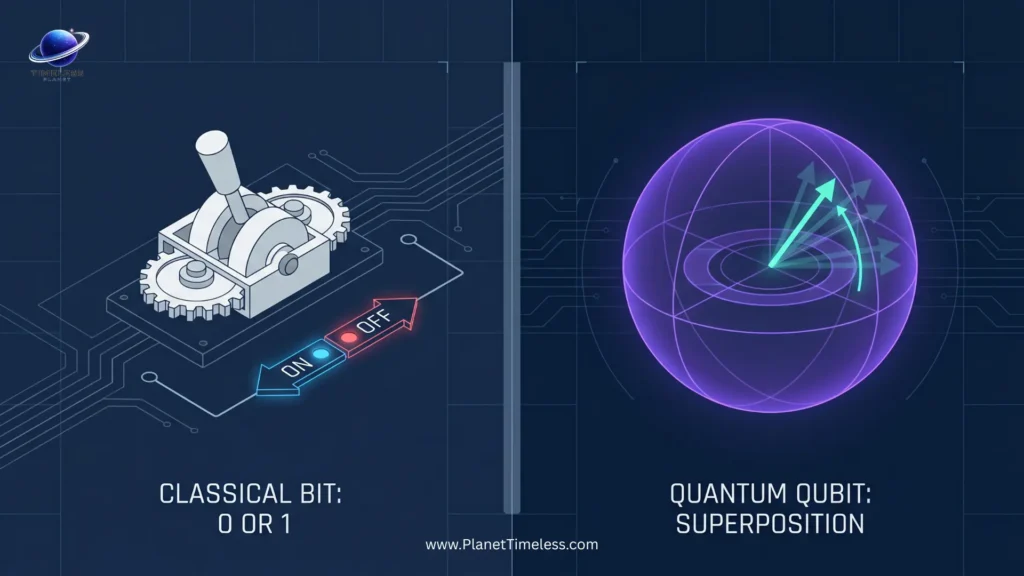
Your laptop, phone, and every server powering the internet run on bits, the smallest unit of information in classical computing. A bit is either a 0 or a 1. Think of it like a light switch: off or on, nothing in between. Every photo, video, message, and calculation on your device is ultimately just billions of these switches flipping at extraordinary speed.
A quantum computer replaces bits with qubits (quantum bits). And qubits don’t have to choose between 0 and 1.
The Light Switch That Can Be Both
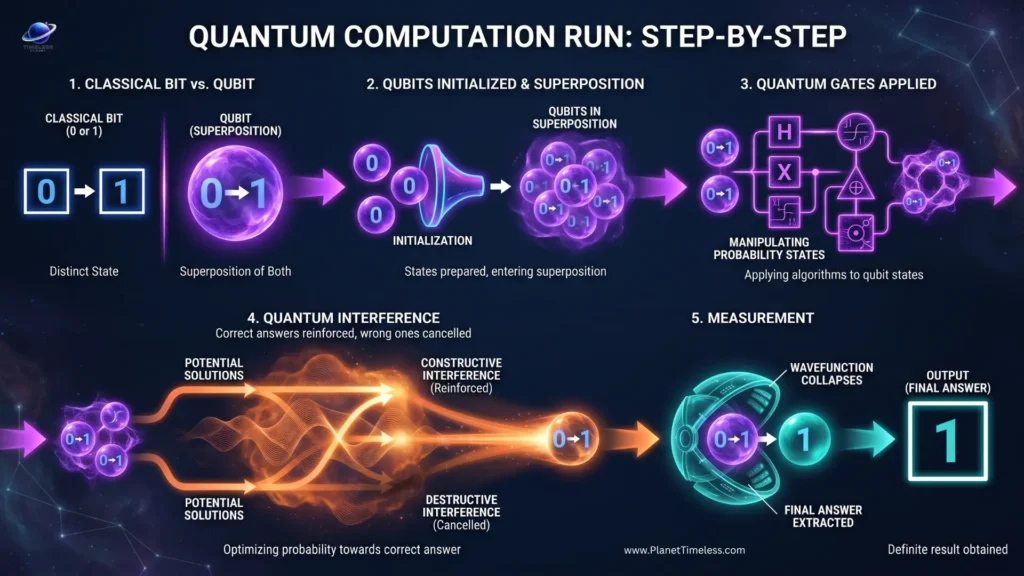
Thanks to a quantum property called superposition, a qubit can exist in a state that’s simultaneously 0 and 1, until you measure it. At that point, it “collapses” into one definite state.
Think of it like spinning a coin. While it’s in the air, it’s neither heads nor tails — it’s both possibilities at once. The moment it lands, reality locks in. Superposition is that mid-spin moment, stretched out and made computationally useful.
Two qubits in superposition can represent four states simultaneously (00, 01, 10, 11). Ten qubits can represent 1,024 states. Fifty qubits? Over a quadrillion states all at once.
This is why quantum computers have the potential to process certain problems at a scale that would take classical computers longer than the age of the universe.
Entanglement: When Qubits Share a Secret
Superposition alone is powerful, but quantum computers get even stranger with entanglement.
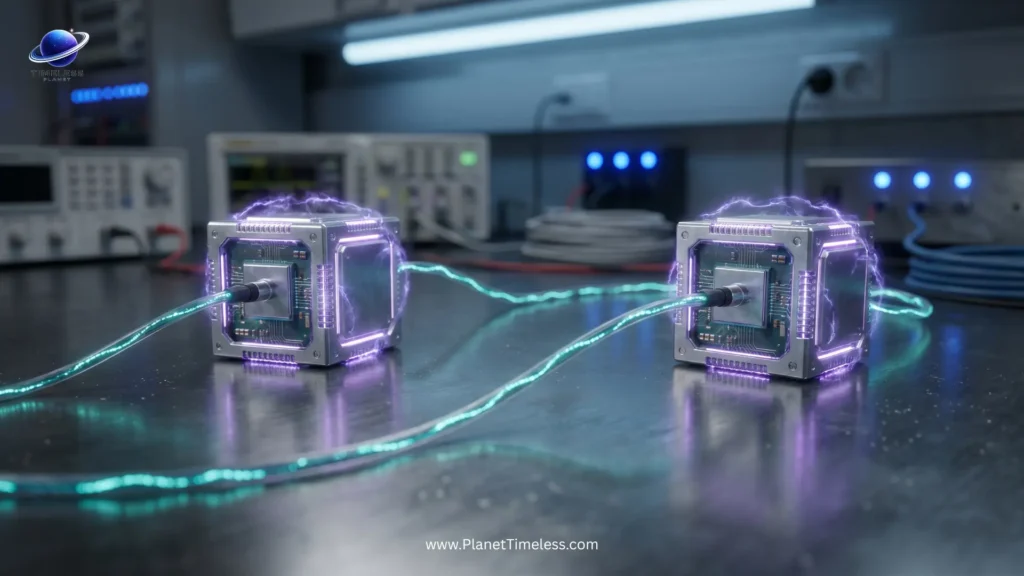
When two qubits become entangled, their states become linked — no matter how far apart they are. Measure one, and you instantly know something about the other. Albert Einstein famously called this “spooky action at a distance,” and he didn’t mean it as a compliment. He thought it implied something was wrong with quantum theory. He was, by most interpretations, wrong.
Inside a quantum computer, entanglement allows groups of qubits to coordinate their calculations in a way that classical bits simply cannot. If superposition is the ability to hold many possibilities at once, entanglement is the ability to make those possibilities work together.
Here’s an analogy: imagine a team of researchers who are telepathically linked. Whenever one learns something, all the others instantly know it too. Classical computers are a team of researchers passing notes. Quantum computers, with entanglement, are the telepathic team.
Why You Can’t Just Simulate This on a Regular Computer
It’s tempting to think a very fast classical computer could fake this. It can’t — at least not efficiently. Simulating the quantum state of 300 qubits on a classical computer would require more memory than there are atoms in the observable universe. The math scales exponentially. This isn’t a matter of hardware improvements; it’s a fundamental difference in how information works at the quantum level.
Quantum Gates: The Logic Behind the Magic
Classical computers use logic gates, tiny electronic components that take inputs, apply rules (AND, OR, NOT), and produce outputs. Billions of these gates, switched in microseconds, run every program you’ve ever used.
Quantum computers have their own equivalent: quantum gates. These are operations that manipulate qubits while they’re still in superposition, rotating their probability states before the final measurement collapses them. The sequence of gates applied to qubits forms what’s called a quantum circuit.
The goal of a well-designed quantum algorithm is to arrange these gates so that correct answers are amplified and wrong answers cancel each other out, a phenomenon called quantum interference. Think of it like noise-canceling headphones: destructive interference kills the wrong signals, leaving the right one clearly audible.
The Biggest Problem: Keeping Qubits Behaving
Here’s where the real engineering nightmare lives. Qubits are extraordinarily fragile.
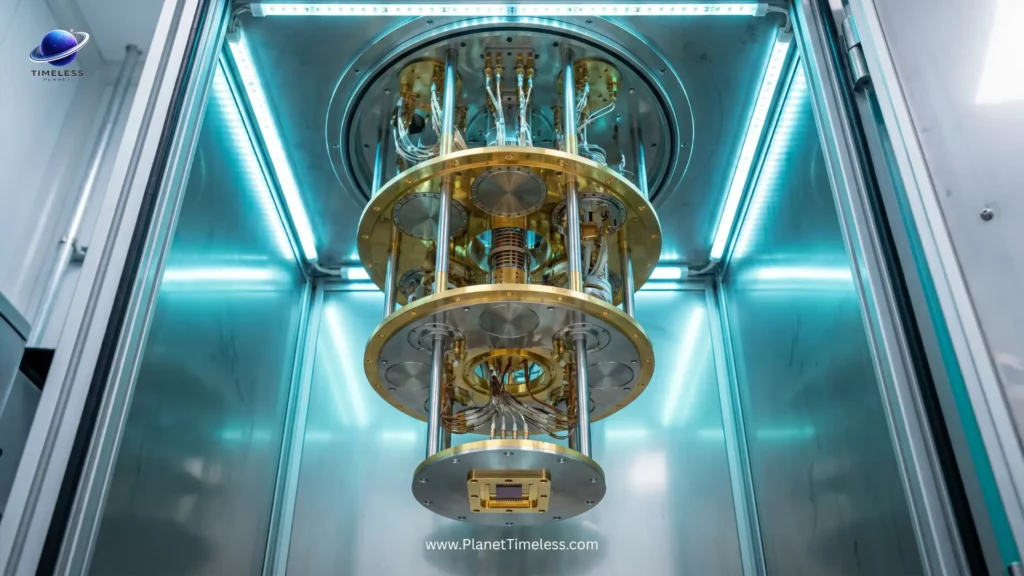
Any interaction with the environment, heat, vibration, stray electromagnetic radiation, even a single photon brushing past, can disrupt a qubit’s quantum state. This is called decoherence, and it’s the reason quantum computers aren’t yet sitting on your desk.
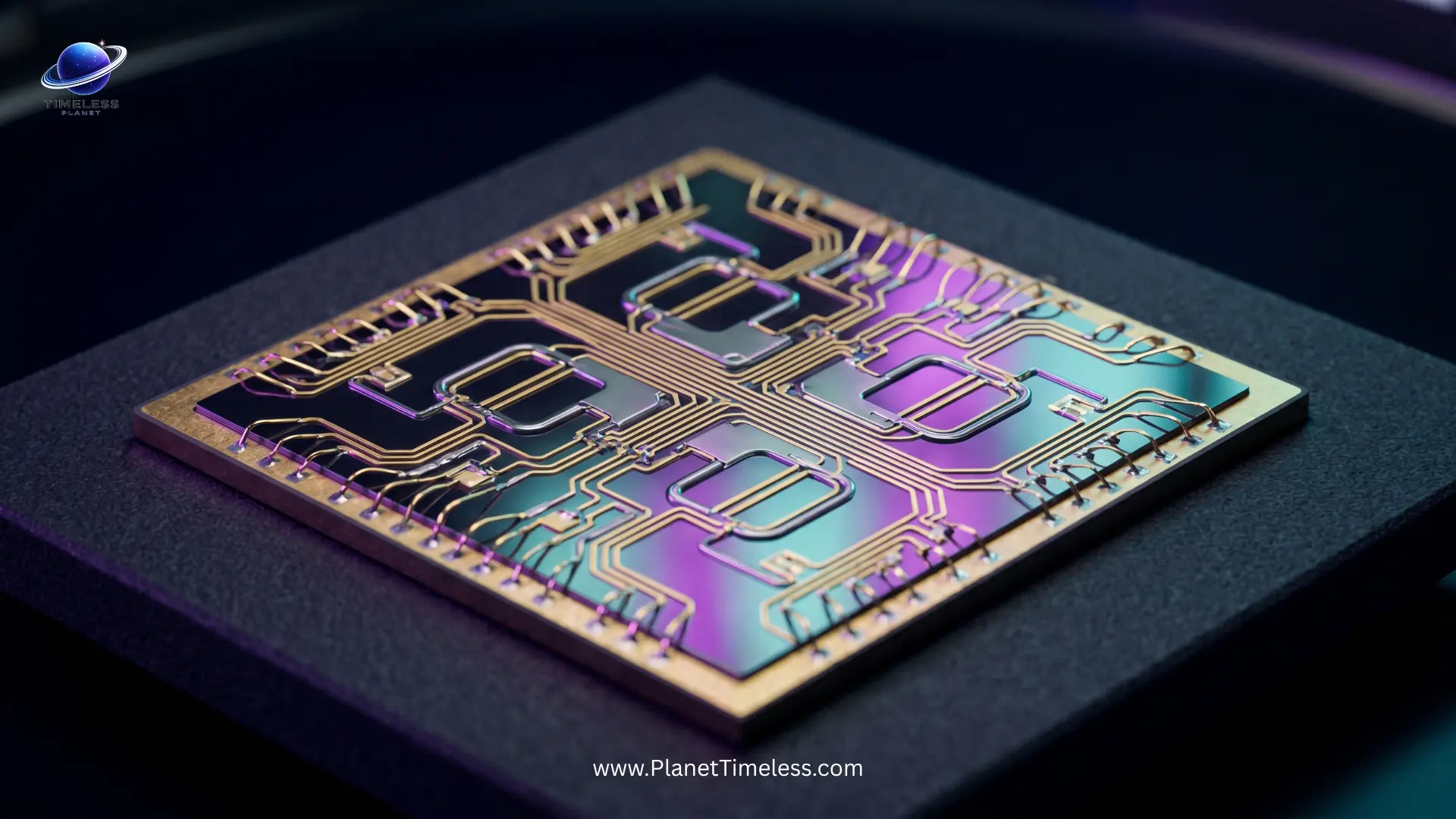
Most quantum processors today operate near absolute zero (around -273°C), colder than outer space, to minimize thermal interference. IBM, Google, and others use superconducting qubits, metal loops cooled to near absolute zero where electricity flows with zero resistance. Other approaches use individual atoms (trapped ion qubits), photons, or nitrogen-vacancy defects in diamonds.
The key engineering challenge isn’t building qubits. It’s keeping them coherent long enough to finish a calculation.
Quantum error correction helps, by spreading one logical qubit across many physical qubits, errors can be detected and fixed without measuring the qubit directly (which would collapse it). But this is enormously resource-intensive. Some estimates suggest a fault-tolerant quantum computer may need thousands of physical qubits for every single logical qubit.
What Quantum Computers Are (and Aren’t) Good For
Quantum computers are not going to replace your laptop. They’re not universally faster — they’re differently suited. For most everyday tasks (word processing, streaming video, browsing the internet), classical computers win easily.
Where quantum computers become extraordinary is for specific classes of problems:
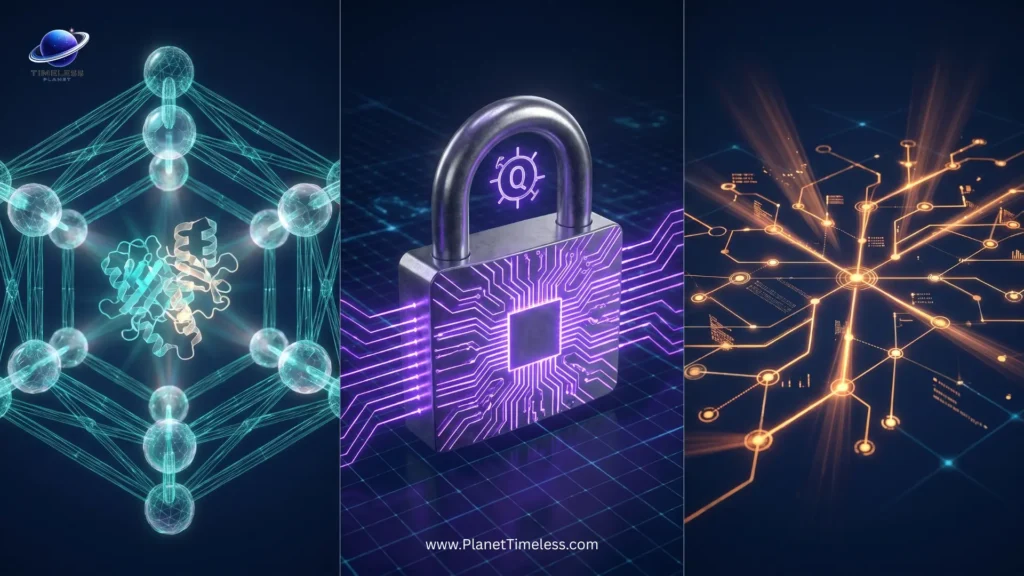
- Cryptography — Most online encryption relies on the extreme difficulty of factoring huge numbers. A sufficiently powerful quantum computer could do this quickly, which is why governments and companies are already developing quantum-resistant encryption.
- Drug discovery and materials science — Simulating molecules at the quantum level is practically impossible for classical computers. For quantum computers, it’s a native task. This could accelerate the discovery of new medicines, batteries, and materials.
- Optimization problems — Routing logistics, financial modeling, scheduling — problems with an enormous number of possible combinations that need a near-optimal solution fast.
- AI and machine learning — Some quantum algorithms could dramatically accelerate training certain types of models.
Frequently Asked Questions
-
Are quantum computers available to the public?
Yes, in a limited way. IBM, Google, and Microsoft offer cloud-based access to quantum processors. IBM’s Quantum Experience lets anyone write and run quantum circuits through a browser. These machines are real but still relatively small and error-prone by the standards needed for practical, large-scale applications.
-
Is a quantum computer just a faster regular computer?
No, and this is one of the most common misconceptions. Quantum computers don’t run the same programs faster. They use completely different principles (superposition, entanglement, interference) to approach specific types of problems in fundamentally different ways. For most tasks, a good classical computer is more practical.
-
What is “quantum supremacy” and has it been achieved?
Quantum supremacy (sometimes called quantum advantage) refers to a point where a quantum computer performs a specific calculation faster than any classical computer could in a reasonable time. Google claimed to have achieved this in 2019 with its Sycamore processor, completing a sampling task in 200 seconds that they estimated would take classical supercomputers 10,000 years. IBM and others disputed the estimate, but the milestone marked a significant moment in the field.
-
When will quantum computers be powerful enough to break encryption?
Current estimates vary widely, but most experts believe a cryptographically relevant quantum computer, one powerful and stable enough to break widely used encryption, is still at least 10 to 20 years away, possibly longer. Significant progress in error correction and qubit stability is needed. Importantly, the cryptography community is already developing quantum-resistant alternatives.
-
How cold do quantum computers need to be?
Most superconducting quantum computers operate at around 15 millikelvin, approximately 0.015 degrees above absolute zero. That’s roughly 180 times colder than the temperature of outer space. Maintaining these temperatures requires specialized dilution refrigerators and is one reason why quantum computers are large, expensive machines, not consumer devices.
The Road Ahead
Quantum computing is still in something like its early transistor era. The first transistors were room-sized, fragile, and limited. Today they’re packed by the billions onto a chip the size of a fingernail.
The trajectory for quantum computing isn’t certain, but the direction is clear. As error correction improves, qubit counts scale up, and operating temperatures potentially rise, the gap between laboratory curiosity and world-changing tool will narrow.
The science is real, the engineering is hard, and the potential is genuinely enormous — particularly in medicine, materials science, and security. Whether the timeline is a decade or three, quantum computing will reshape what computation itself means.
If you found this useful, share it with someone who thinks “quantum” just means “really fast.” They deserve a better explanation.
Suggested article: What Is Quantum Entanglement?
1 thought on “How Quantum Computers Work: Qubits, Superposition & Entanglement Explained”