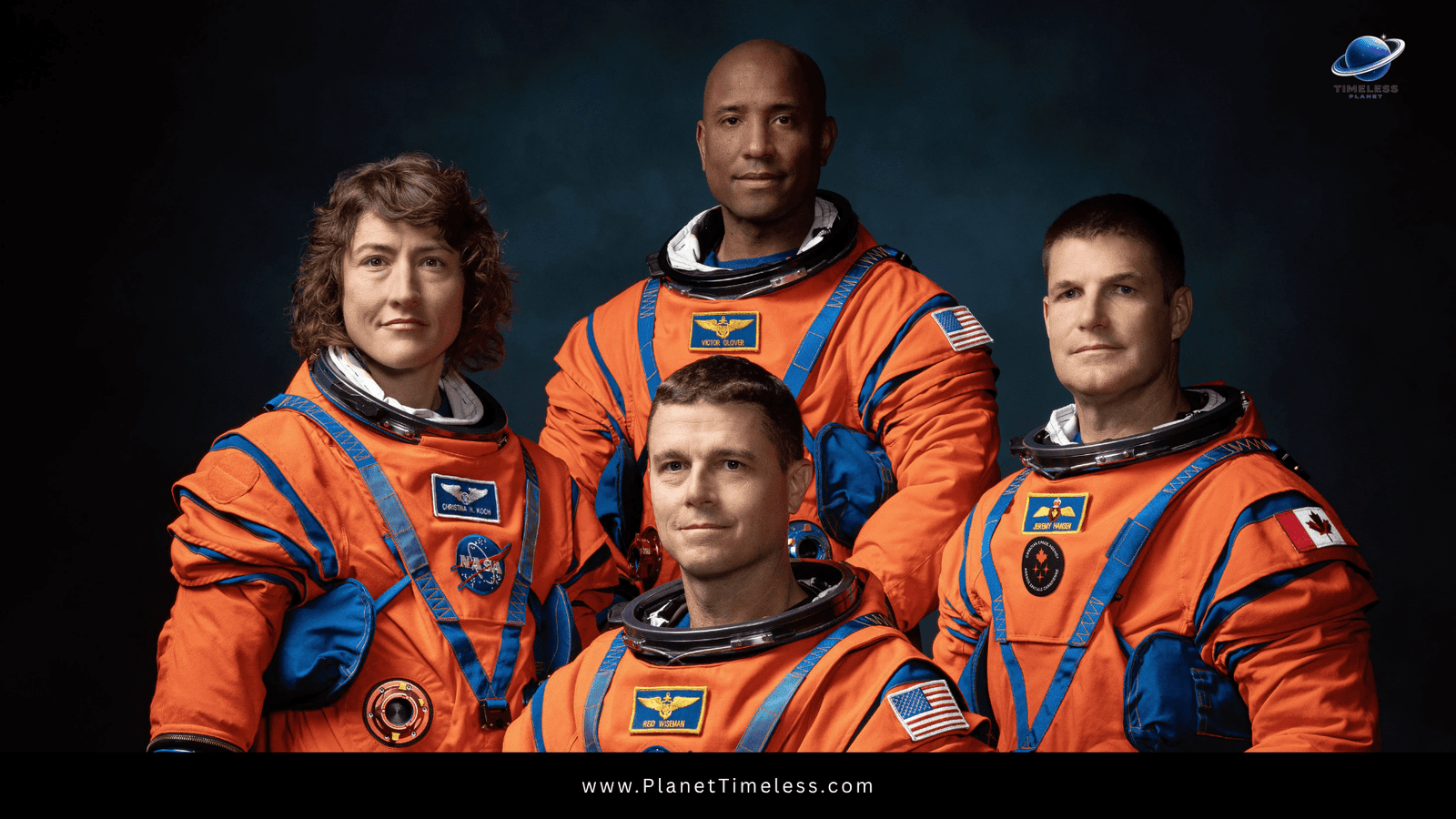
On April 1, 2026, four astronauts climbed aboard a spacecraft named Integrity and did something no human being had done in more than half a century they left the safety of Earth’s orbit and flew around the Moon.
The Artemis II mission, launched from NASA’s Kennedy Space Center atop the mighty Space Launch System (SLS) rocket, was not just a technological achievement. It was a deeply human one. For 10 days, Commander Reid Wiseman, Pilot Victor Glover, Mission Specialist Christina Koch, and Canadian Mission Specialist Jeremy Hansen traveled 694,481 miles through deep space, circled the Moon on April 6, and splashed down safely in the Pacific Ocean on April 10, 2026.
This was the first crewed flight of NASA’s Artemis program and the first time humans had journeyed beyond low Earth orbit since Apollo 17 in December 1972. After more than 50 years of waiting, humanity was back near the Moon. And this time, the crew looked different from any Moon mission before it.
This post is your complete guide to the Artemis II crew who they are, what records they broke, what they did in space, and why this mission matters for the future of human exploration.
Who Were the Artemis II Crew Members?
NASA announced the four-person crew in April 2023, giving them nearly three full years to train together. Each member brought a unique background and a groundbreaking “first” to the mission.
1. Reid Wiseman — Commander
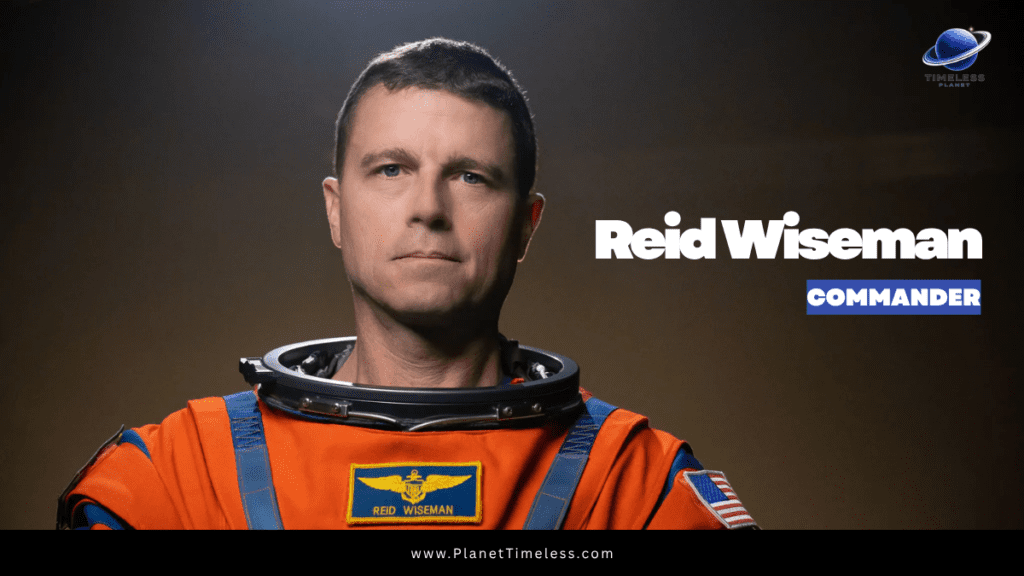
Reid Wiseman led the Artemis II crew as its commander, making him one of the most experienced leaders in NASA’s modern astronaut corps. A former U.S. Navy test pilot, Wiseman had previously served aboard the International Space Station (ISS) as a flight engineer during Expedition 41 a 165-day mission in which his crew completed a record 82 hours of scientific research in a single week.
Before being assigned to Artemis II, Wiseman served as NASA’s Chief Astronaut, a role that placed him as the primary link between the astronaut corps and NASA leadership during the difficult years of the COVID-19 pandemic. He stepped down from that role in late 2022 specifically to return to active flight status and pursue a crew assignment.
As commander of Artemis II, Wiseman sat in the left seat of Orion’s cockpit at launch, monitoring all systems while the flight ran on automation. His responsibility was total crew safety from launch through splashdown. He also became one of the oldest humans ever to travel beyond Earth orbit.
Wiseman holds a Bachelor of Science in Computer and Systems Engineering from Rensselaer Polytechnic Institute and a Master of Science in Systems Engineering from Johns Hopkins University.
2. Victor Glover — Pilot
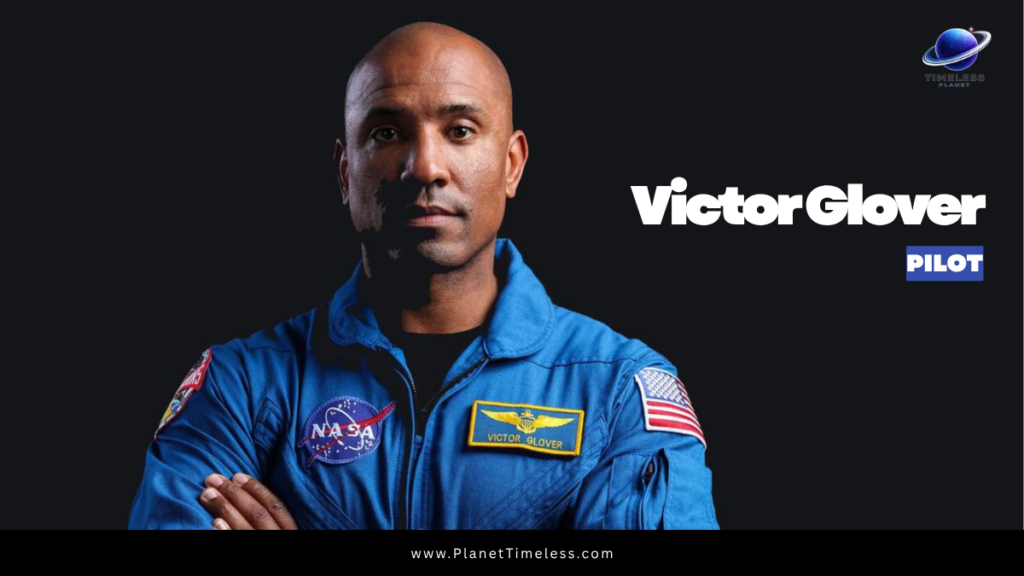
Victor Glover made history on Artemis II as the first person of color to travel to the vicinity of the Moon. As mission pilot, he was responsible for spacecraft guidance, attitude management, and flight systems throughout the mission including a planned manual control demonstration test during the mission’s outbound phase.
Glover was no stranger to space. His first mission, the SpaceX Crew-1 flight in 2020, made him the first Black astronaut to serve a long-duration assignment on the ISS. He spent 168 days in space on Expedition 64, completed four spacewalks, and contributed to dozens of scientific investigations.
A U.S. Navy Captain and decorated naval aviator, Glover is a test pilot who flew the F/A-18 Hornet, Super Hornet, and EA-18G Growler. He holds five advanced degrees, including a master’s degree in flight test engineering and one in systems engineering.
At the Artemis II crew announcement in 2023, Glover beautifully captured the spirit of the mission: human spaceflight, he said, is not a marathon it is a series of sprints, powered by the thousands of people who work tirelessly behind the scenes.
His inclusion in this mission was far more than symbolic. It was a statement about who belongs in space — and who always did.
3. Christina Koch — Mission Specialist
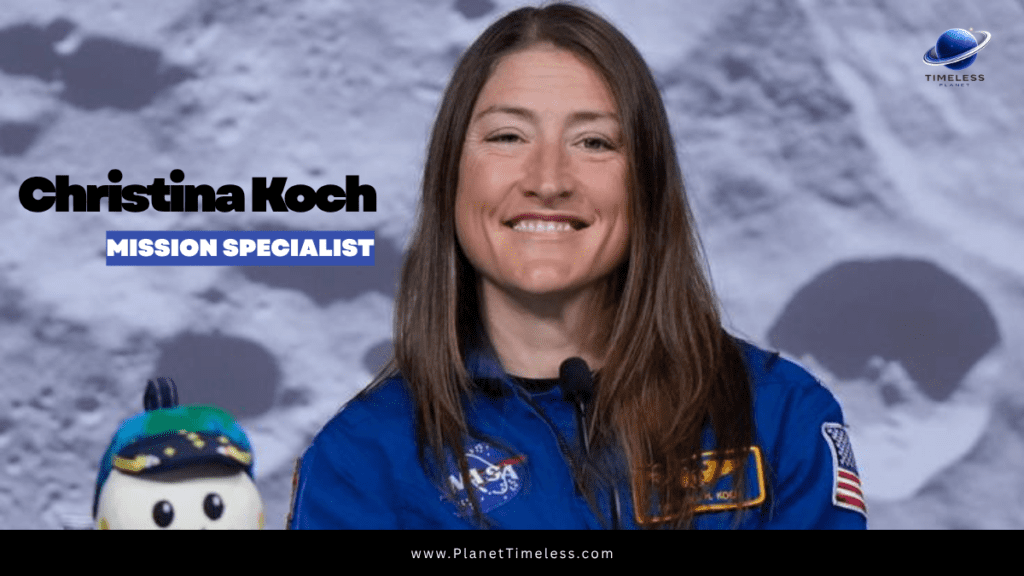
Christina Koch already had her name in the record books before Artemis II. She holds the record for the longest single spaceflight by a woman 328 consecutive days in space aboard the ISS from 2019 to 2020. She also participated in the first-ever all-female spacewalks during Expedition 61.
On Artemis II, Koch served as Mission Specialist 1, responsible for leading crew procedures, onboard science operations, and managing the mission timeline throughout the translunar flight. Her deep spaceflight experience made her a key anchor for the mission’s daily operational tempo.
As the first woman to fly beyond low Earth orbit, Koch’s place in the Artemis II crew represented a milestone that advocates had hoped for since the dawn of the Space Age. Women have long contributed to space exploration from the Hidden Figures mathematicians of the 1960s to today’s engineers and astronauts. Koch’s lunar flyby put an end to the era in which no woman had flown beyond Earth’s neighborhood.
Koch studied at North Carolina State University, earning dual Bachelor of Science degrees in Electrical Engineering and Physics, along with a Master of Science in Electrical Engineering.
4. Jeremy Hansen — Mission Specialist
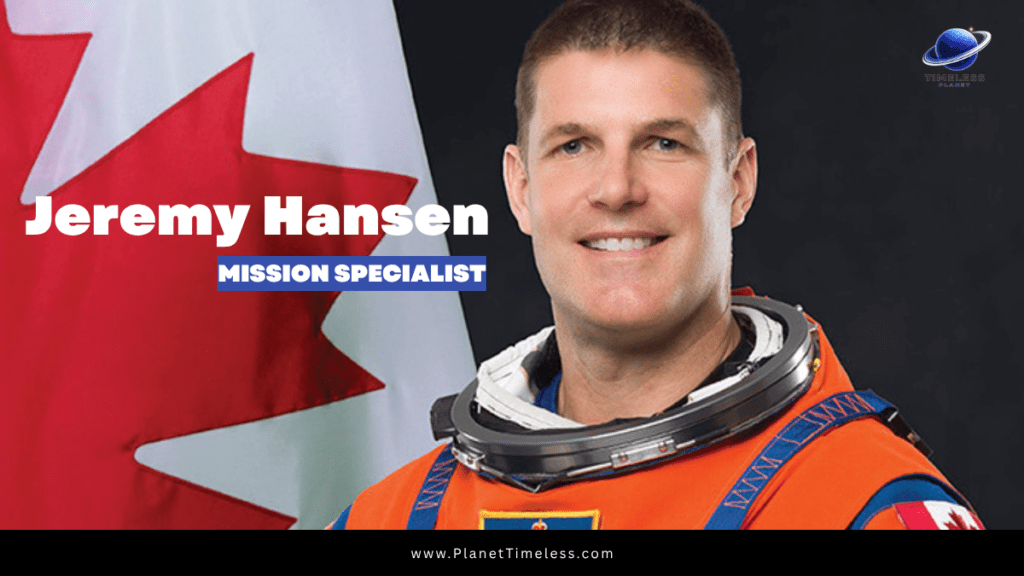
Jeremy Hansen of the Canadian Space Agency (CSA) made history as the first non-American astronaut to fly to the vicinity of the Moon and, remarkably, Artemis II was his very first spaceflight.
A Colonel in the Royal Canadian Air Force and a CF-18 fighter pilot, Hansen was selected as a CSA astronaut in 2009. In the years that followed, he became deeply embedded in NASA operations serving as a CAPCOM (capsule communicator) in Mission Control and, in 2017, becoming the first Canadian ever to lead a NASA astronaut training class.
Hansen’s inclusion in the Artemis II crew was made possible by a 2020 treaty between the United States and Canada, which granted the CSA a seat on a crewed lunar mission in exchange for Canada’s contribution to the Lunar Gateway program. His presence aboard Integrity symbolized the international character of the Artemis era a vision where the Moon belongs to all of humanity.
Despite being a space rookie, Hansen carried his responsibilities with confidence. He and Koch were the first to unstrap after launch and set up life support systems in the Orion cabin a critical early task in the mission. The crew even incorporated five Canadian food products into their menu in his honor.
The Mission: What Artemis II Actually Did
The Artemis II mission launched at 6:35 p.m. EDT on April 1, 2026, from Launch Pad 39B at Kennedy Space Center. The SLS core stage burned for approximately eight minutes, delivering Orion into a highly elliptical orbit before the upper stage fired to send the crew toward the Moon.
Over the first two days, the crew checked out Orion’s systems in near-Earth space. Koch and Hansen performed a critical systems check immediately after launch verifying life support, water dispensers, and yes, even the toilet (which had a few minor hiccups early on).
By day six, the crew reached their closest point to the Moon, swinging around its far side on April 6. They became the first humans to see parts of the lunar far side with their own unaided eyes a sight no human had ever witnessed in real time. They relayed descriptions to NASA scientists and captured images, videos, and voice recordings that researchers will study for years.
The spacecraft, named Integrity by the crew, also carried a zero-gravity indicator a plush toy named “Rise,” designed by eight-year-old Lucas Ye of Mountain View, California, the winner of a NASA design challenge with over 2,600 entries from 50 countries. Rise was inspired by the famous Apollo 8 “Earthrise” photograph. At mission’s end, Commander Wiseman couldn’t bear to leave Rise behind, so he tucked it into his dry bag. It has since been displayed at post-mission press conferences.
Splashdown occurred on April 10, off the coast of San Diego, with Orion landing just 2.9 miles from its targeted site — a remarkable display of precision. The crew was recovered by U.S. Navy divers and helicopters, transported to the USS John P. Murtha, and ultimately returned to NASA’s Johnson Space Center in Houston.
Wiseman’s words after splashdown said everything: “We are bonded forever, and no one down here is ever going to know what the four of us just went through. And it was the most special thing that will ever happen in my life.”
Records Broken by the Artemis II Crew
The Artemis II mission shattered multiple records in human spaceflight:
- First crewed flight beyond low Earth orbit since Apollo 17 (1972) — breaking a 54-year gap.
- First woman to fly to the vicinity of the Moon — Christina Koch.
- First person of color to fly to the vicinity of the Moon —Victor Glover.
- First non-American astronaut to fly to the Moon — Jeremy Hansen (Canada).
- Most people in deep space simultaneously — four, surpassing the record of three set by Apollo 8 in 1968.
- Longest distance traveled by humans from Earth — the crew flew farther than any humans before them aboard Integrity.
Why Artemis II Matters for the Future
Artemis II was not just a victory lap. It was a critical test flight that will directly enable humans to land on the Moon for the first time since 1972 aboard Artemis IV, currently targeting 2028.
Every system Wiseman and his crew validated in deep space the Orion life support systems, the heat shield, the propulsion, the communications feeds directly into planning for Artemis III (targeting 2027) and the eventual crewed lunar landing. Orion’s heat shield performed significantly better during Artemis II’s reentry than it did on the uncrewed Artemis I mission, reducing concerns that had delayed the program.
The crew’s 694,481-mile journey also demonstrated that international partnerships, diverse crews, and cutting-edge hardware can come together seamlessly in the most demanding environment imaginable. That is the foundation NASA is building upon for a sustained human presence on the Moon and eventually, a crewed mission to Mars.
Conclusion: A Crew for the History Books
The Artemis II crew — Reid Wiseman, Victor Glover, Christina Koch, and Jeremy Hansen did not just fly to the Moon. They flew for everyone who has ever looked up at the night sky and wondered if we could go back. They flew for the scientists, the engineers, the kids who submitted zero-gravity indicator designs from 50 countries, and the generations who grew up watching Apollo footage in black and white.
They broke records. They made history. And perhaps most importantly, they proved it is possible and they brought back the proof.
The Moon is not behind us. It is ahead of us. And Artemis II just showed us the way.

Connect with us
Sources: NASA.gov, Wikipedia (Artemis II), National Air and Space Museum, ABC News, Kennedy Space Center Visitor Complex
Frequently Asked Questions (FAQ)
-
When did the Artemis II mission take place?Artemis II launched on April 1, 2026, and splashed down on April 10, 2026, a nearly 10-day mission.
-
Who were the Artemis II crew members?Commander Reid Wiseman, Pilot Victor Glover, Mission Specialist Christina Koch (all NASA), and Mission Specialist Jeremy Hansen (Canadian Space Agency).
-
Did Artemis II land on the Moon?No. Artemis II was a lunar flyby — a crewed test flight designed to validate the Orion spacecraft’s systems. A crewed Moon landing is planned for a later Artemis mission.
-
What records did Artemis II break?It was the first crewed deep space mission in 54 years, the first with a woman and a person of color to fly to the Moon’s vicinity, the first with a non-American on a lunar mission, and set the record for most people in deep space at once.
-
What is the Orion spacecraft named?The crew named their Orion spacecraft Integrity
-
What comes next after Artemis II?Artemis III is targeted for 2027 to test rendezvous and docking with commercial landers, with the first crewed Moon landing planned for Artemis IV in 2028.
2 thoughts on “Artemis II: The Crew Making History Around the Moon (2026)”