
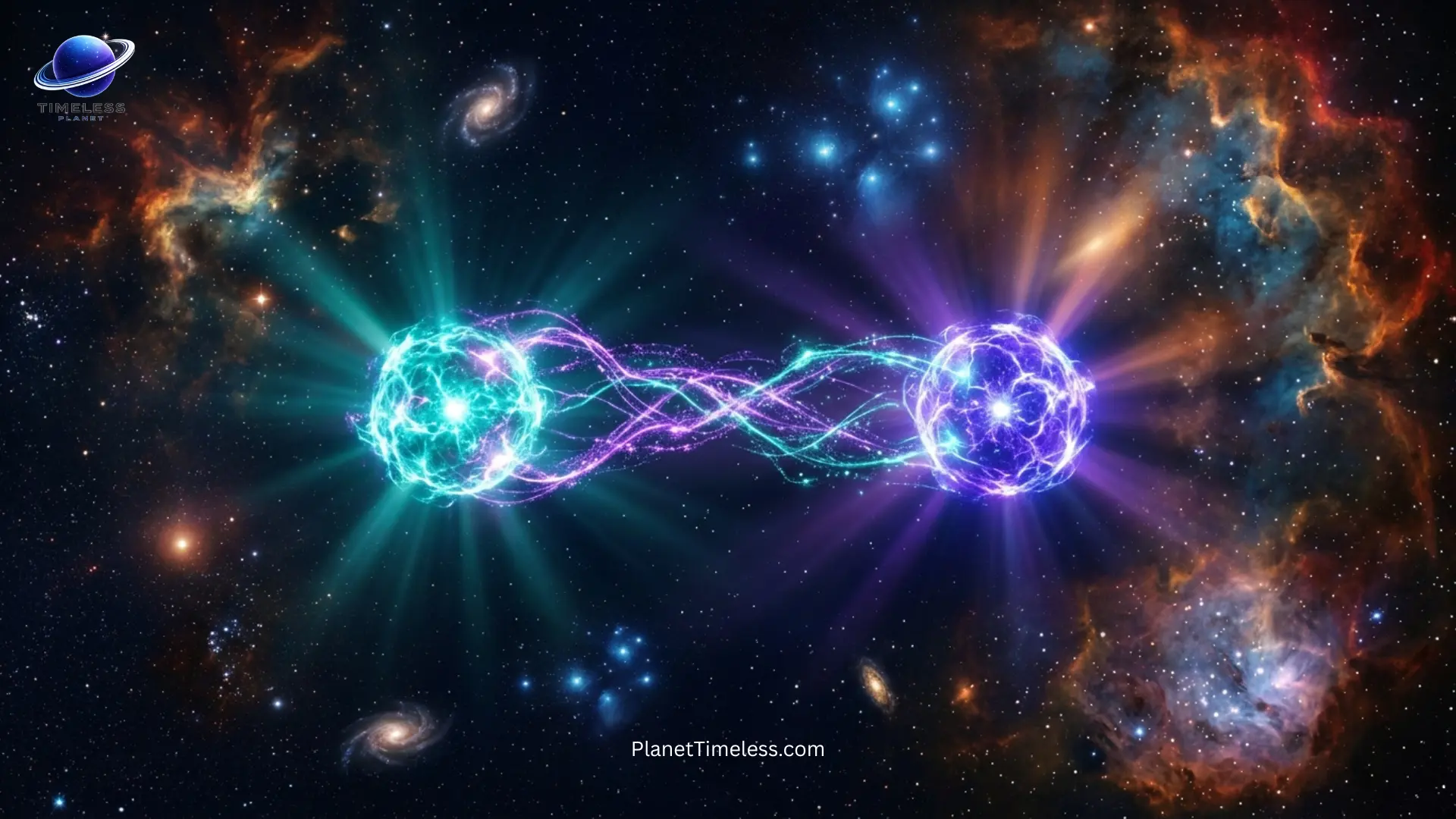
Imagine two magic coins. You flip one in New York and it lands heads. At that exact same moment, your friend flips the other coin in Tokyo — and it lands tails. Every single time. No matter how far apart those coins are. No signal passed between them. No trick. Just physics.
That’s the closest everyday comparison to quantum entanglement — and it genuinely bothered Albert Einstein so much that he spent years trying to prove it was wrong. He lost.
What Actually Is Quantum Entanglement?
At the quantum level — the world of electrons, photons, and other subatomic particles — the rules of reality get strange fast.
When two particles become entangled, they don’t just influence each other. They become part of a single system. Their properties — spin, polarization, momentum — aren’t decided until the moment you measure one of them. And the instant you do, the other particle’s property is instantly determined too, no matter how far away it is.
Not fast. Not nearly instantaneous. Instantly. Across any distance.
Why Einstein Hated It
Einstein called it “spukhafte Fernwirkung” — spooky action at a distance. He was convinced there had to be a hidden explanation. Maybe the particles carried pre-set information, like a secret note tucked into each coin before the experiment. Physicists call this idea “hidden variables.”
In 1964, physicist John Bell designed a mathematical test to check whether hidden variables could explain entanglement. Decades of experiments have since confirmed: they can’t. The particles genuinely don’t have a fixed state until you look. The universe really is that strange.
How Do Particles Become Entangled?
You can’t just shake two electrons and call it done. Entanglement happens under specific controlled conditions — usually in particle physics experiments or laser labs.
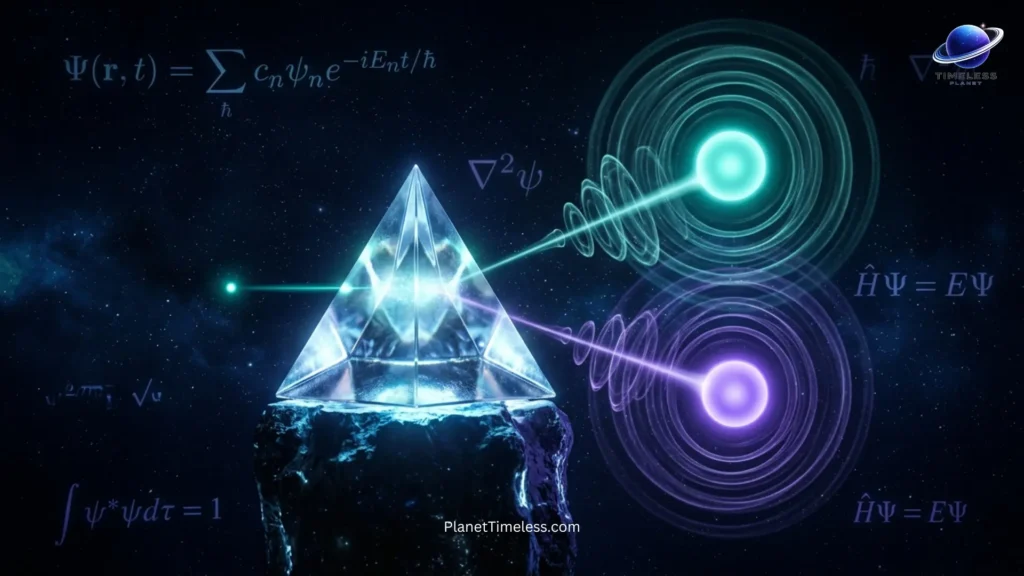
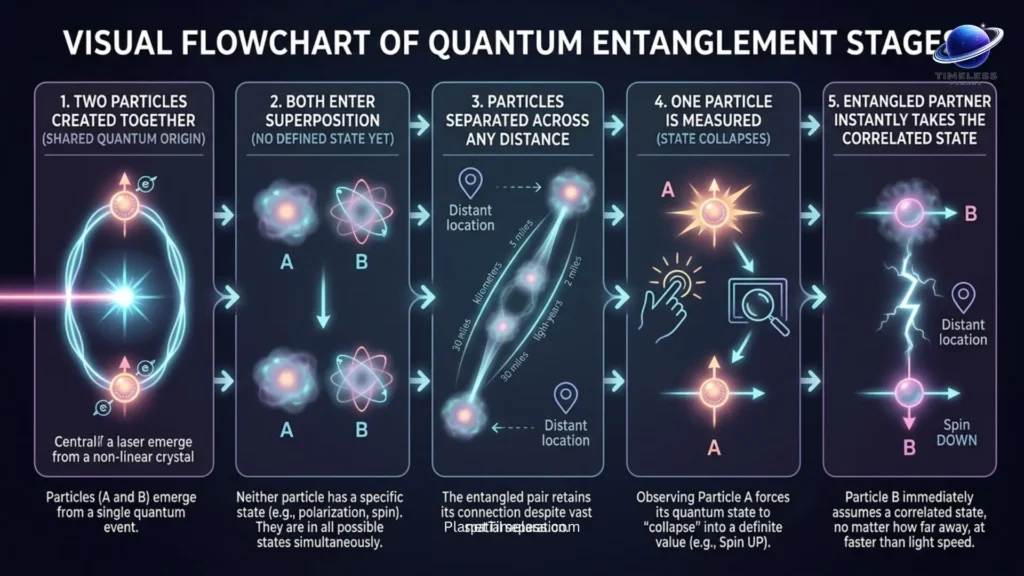
A common method involves shining a laser through a special crystal that splits one photon into two. These two photons emerge with opposite polarizations, but neither one has a defined polarization yet. They’re both in superposition — existing in all possible states at once, like a coin spinning in the air before it lands.
The moment you measure one photon’s polarization, it “chooses” a state. And instantaneously, its entangled partner snaps to the opposite state. They’ve never communicated. There’s no signal. It just happens.
Superposition: The Setup for Everything
Think of superposition like a playing card held face-down. Until you flip it over, it’s neither the ace of spades nor the two of hearts — it’s both, in a sense. The act of looking forces it to pick one.
Quantum particles live in this indefinite state constantly. Entanglement links two of these indefinite states so that the moment one resolves, the other instantly resolves too — and always in a correlated way.
Does This Mean Information Travels Faster Than Light?
This is the question everyone asks — and the answer is one of physics’ more satisfying answers: no, but the reason why is genuinely interesting.
When your entangled particle is measured and the result is random, you can’t control what result you’ll get. You’ll get heads or tails with equal probability. That means you can’t encode a message in the result and send it to someone across the galaxy. There’s nothing to transmit because you can’t choose the outcome.
The entanglement effect is real, confirmed, and not explained by anything classical physics offers. But it doesn’t carry usable information faster than light. Einstein’s special relativity stays intact — barely, and through what feels like a cosmic loophole.
Think of it this way: two people in different cities could both receive a pair of gloves from the same shipment. The moment person A opens the box and finds the left glove, they instantly “know” person B has the right glove — but no information traveled. The correlation was built in. Quantum entanglement is stranger than this analogy, but the logic of why it doesn’t break causality is similar.
Where Does Quantum Entanglement Actually Show Up?
This isn’t just a lab curiosity. Entanglement is already being put to work in the real world.
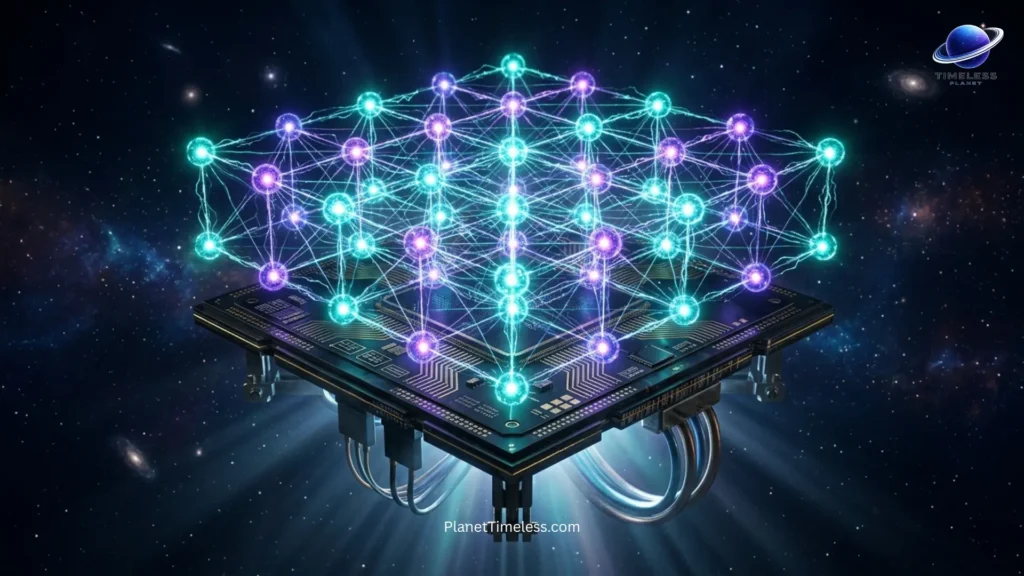
Quantum computing uses entangled particles as qubits — the quantum equivalent of computer bits. Because entangled qubits can represent multiple states simultaneously and correlate with each other in precise ways, quantum computers can solve certain problems exponentially faster than any classical machine.
Quantum cryptography — specifically quantum key distribution (QKD) — uses entanglement to create communication channels that are theoretically unhackable. Any attempt to eavesdrop on an entangled transmission physically disturbs the system, making interception detectable.
Quantum teleportation has already been demonstrated in labs. Not teleporting matter — not yet — but teleporting the quantum state of a particle to another location. In 2022, researchers teleported quantum information over 44 kilometers of fiber optic cable in a real-world urban network.
The Quantum Internet Is Coming
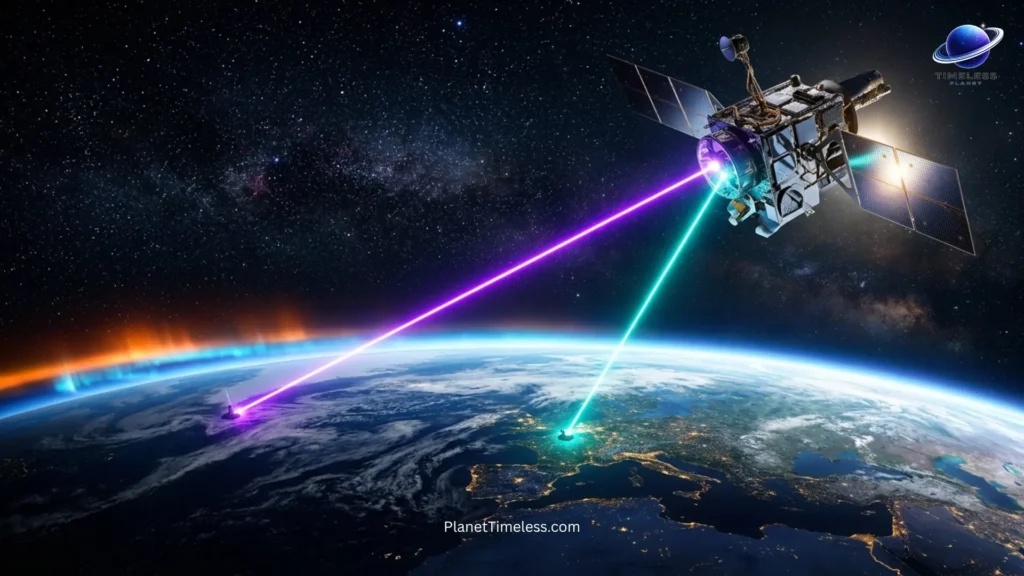
Scientists at institutions including Caltech, MIT, and China’s QUESS satellite project are working toward a quantum internet — a communication network secured by the laws of physics themselves, not just encryption algorithms. Entanglement is the backbone.
The Weirdest Fact About the Universe Might Also Be Its Most Useful
Quantum entanglement is strange enough to make your head hurt on a Tuesday afternoon. But it’s not just a philosophical puzzle — it’s becoming infrastructure.
The same phenomenon that drove Einstein to distraction is now being engineered into computers, satellites, and communication networks that will reshape how humanity processes and protects information.
If you want to understand the future of technology, understanding entanglement is where it starts. Share this article with someone who thinks quantum physics is too abstract to matter — then watch their face when they realize it’s already in the lab down the street.
Got a question about quantum entanglement we didn’t cover? Drop it in the comments — we read every one. And if you want to go deeper, check out our piece on how quantum computers actually work and [what superposition really means].
Also Read: Space Articles
Frequently Asked Questions
-
Is quantum entanglement proven or just theoretical?
It’s thoroughly proven. Decades of experiments, including Nobel Prize-winning work by Alain Aspect, John Clauser, and Anton Zeilinger in 2022, have confirmed that quantum entanglement is a real physical phenomenon — not a theoretical construct or a measurement glitch.
-
Can quantum entanglement be used to communicate faster than light?
No, While the correlation between entangled particles is instant, you can’t control the outcome of a quantum measurement, so you can’t encode information in it. The results are random on each end. No usable message can be transmitted this way.
-
How far apart can two entangled particles be?
There’s no known distance limit. Experiments have confirmed entanglement over distances of more than 1,200 kilometers via satellite (China’s Micius satellite, 2017). In principle, entangled particles could remain correlated across the entire observable universe.
-
Can humans or large objects become quantum entangled?
Quantum effects typically vanish at large scales because of a process called decoherence — interactions with the environment constantly “measuring” particles and collapsing their quantum states. Entanglement has been demonstrated with molecules and even tiny mechanical devices, but everyday objects at room temperature are too large and too “noisy” for entanglement to persist.
-
What did Einstein get wrong about quantum entanglement?
Einstein believed entanglement must be explained by hidden variables — pre-determined information carried by each particle. He thought quantum mechanics was incomplete. Bell’s theorem and subsequent experiments showed this isn’t the case. The universe appears to be genuinely probabilistic at its core, not hiding a deterministic layer underneath.
1 thought on “What Is Quantum Entanglement? The Spooky Science Explained Simply”