
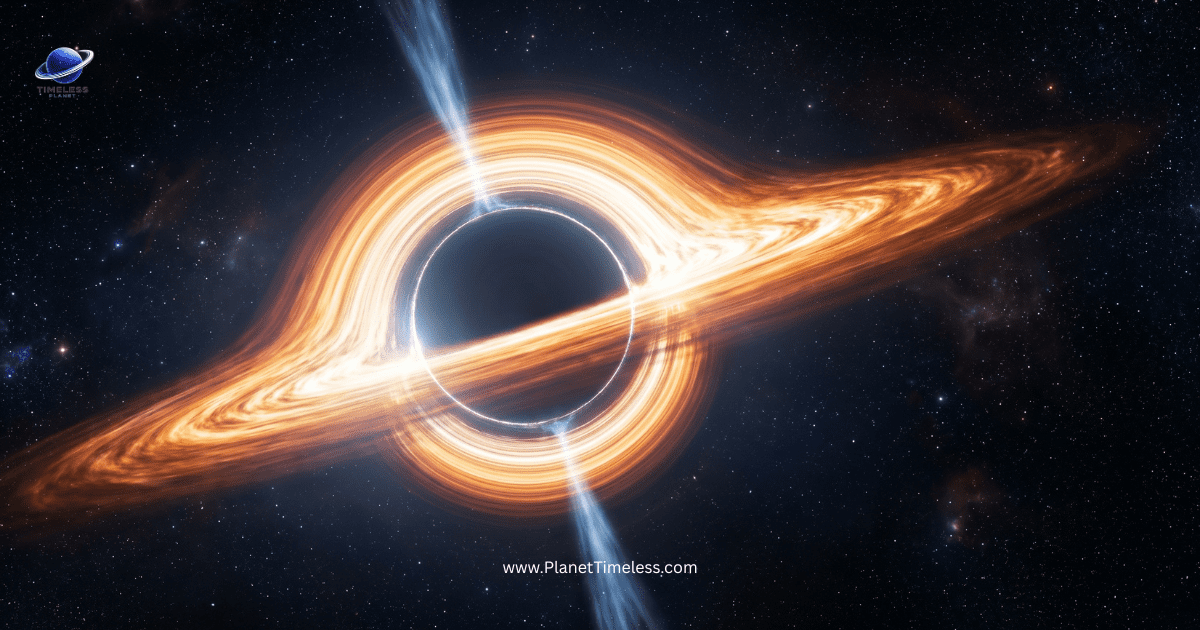
A black hole is a region in space where gravity is so extreme that nothing — not even light — can escape. They form when massive stars collapse at the end of their lives, crushing enormous amounts of matter into an incredibly tiny space. There are three main types: stellar, intermediate, and supermassive black holes. The boundary surrounding a black hole, called the Event Horizon, marks the point of no return. Scientists study black holes because they sit at the intersection of our two greatest theories of physics — general relativity and quantum mechanics — and understanding them may unlock the deepest secrets of the universe.
Introduction: The Most Extreme Objects in the Universe
Imagine something so dense, so gravitationally violent, that it bends the very fabric of space and time around it. Imagine a region of the cosmos so dark that light itself — the fastest thing in existence — cannot escape its pull. That is a black hole. And the more scientists study them, the stranger and more fascinating they become.
For decades, black holes lived almost entirely in the realm of mathematics and theory. Today, they are front-page news. In 2019, humanity photographed one for the first time. In 2022, we photographed the supermassive black hole sitting at the heart of our own Milky Way galaxy. In 2025, scientists confirmed the oldest known black hole — formed just 500 million years after the Big Bang — as well as the largest merger of two black holes ever recorded. These are objects that sit at the very edge of what physics can currently explain, and that is precisely why scientists cannot stop talking about them.
Whether you have always been curious about black holes or are encountering the topic for the first time, this guide will take you from the absolute basics all the way to the cutting edge of what we know in 2026.
What Is a Black Hole? The Simple Explanation
At its most basic, a black hole is a region of space where the gravitational pull is so strong that the escape velocity — the speed you would need to travel to break free — exceeds the speed of light. Since nothing in the universe travels faster than light, nothing escapes. Not radiation. Not particles. Nothing.
Every black hole has two key components:
The Singularity At the very centre of a black hole lies the singularity — a point of theoretically infinite density where all the mass is concentrated. At the singularity, our current laws of physics break down completely. General relativity cannot accurately describe what happens there, and this is one of the great unsolved puzzles of modern science.
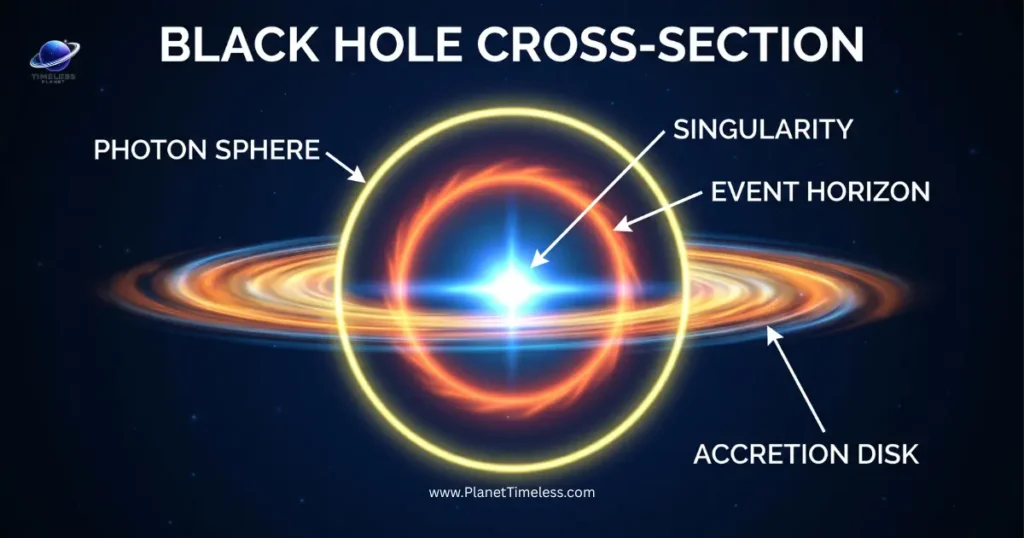
The Event Horizon Surrounding the singularity is the event horizon — the “point of no return.” Think of it not as a physical surface but as an invisible boundary. Cross it, and you are forever inside. Importantly, if you were to fall through the event horizon of a supermassive black hole — say, the one at the centre of a large galaxy — you might not feel anything unusual as you cross it. The tidal forces at such a vast horizon can actually be quite gentle. The danger comes later, as you spiral inward toward the singularity.
What lies beyond the event horizon? We genuinely do not know. This is one of the biggest open questions in all of physics.
How Do Black Holes Form?
Most black holes form when a massive star, typically at least 20 times the mass of our Sun, runs out of nuclear fuel and collapses. The outer layers explode in a supernova while the core implodes, crushing into an incredibly dense object. If the core is massive enough, gravity wins completely and a black hole is born. Supermassive black holes, found at the centres of galaxies, are thought to have formed through repeated mergers and rapid growth in the early universe, though their exact origin remains an active area of research.
Stellar Collapse: The Birth of a Black Hole
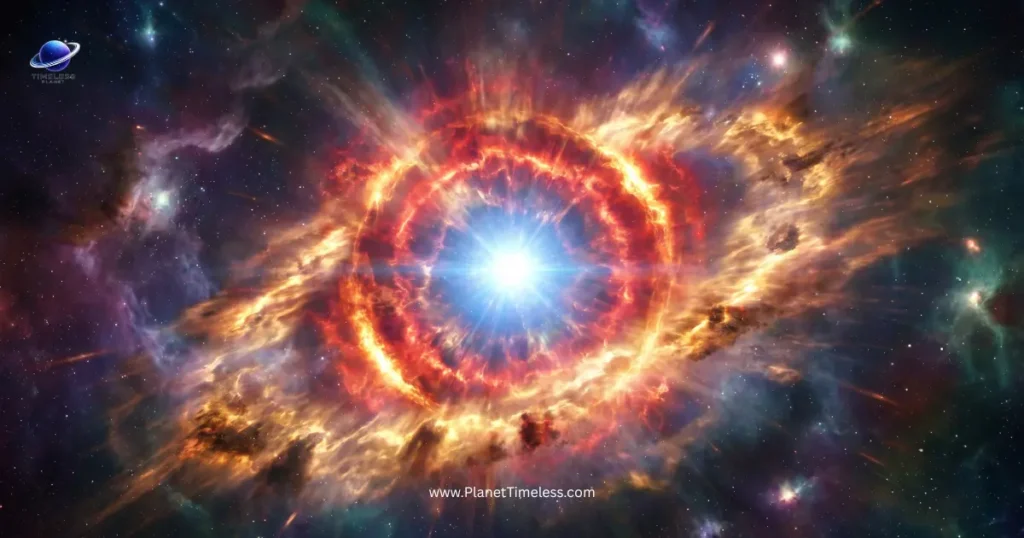
Stars are sustained by an ongoing battle between two forces: the outward push of nuclear fusion and the inward pull of gravity. For most of a star’s life, these forces are in balance. But when a sufficiently massive star burns through its nuclear fuel, fusion stops. With nothing pushing outward, gravity wins in an instant. The outer layers of the star are blasted outward in a spectacular explosion called a supernova. The core, however, has nowhere to go — it collapses under its own gravity so completely that it forms a black hole.
Not every star becomes a black hole. Our own Sun, for example, will one day swell into a red giant and then shrink into a cool white dwarf. Black hole formation requires a star with at least roughly 20 times the mass of the Sun, though the exact threshold depends on several factors including rotation and composition.
The Mystery of Supermassive Black Holes
Then there are the true giants — supermassive black holes — which contain anywhere from millions to tens of billions of times the mass of the Sun. Sagittarius A*, the supermassive black hole at the centre of our own Milky Way, has a mass of about 4 million suns. The black hole at the heart of the galaxy M87, the first to be directly imaged, tips the scales at around 6.5 billion solar masses.
How did these behemoths form? That remains one of the biggest open questions in astrophysics. The most widely accepted theories suggest they grew through a combination of repeated black hole mergers and rapid “feeding” — consuming enormous quantities of surrounding gas, dust, and stars over billions of years. The James Webb Space Telescope has complicated this picture considerably by finding supermassive black holes that are simply too large, too early in the universe’s history to have grown through those slow processes alone.
The Three Types of Black Holes
Scientists recognise three main confirmed categories of black holes:
- Stellar black holes — formed from collapsed stars, ranging from a few to ~100 solar masses;
- Intermediate black holes — a recently confirmed “missing link” category, ranging from 100 to 100,000 solar masses; and
- Supermassive black holes — the cosmic titans at the centres of most large galaxies, ranging from millions to billions of solar masses. A possible fourth category, primordial black holes, may have formed in the extreme conditions just after the Big Bang, though none have been confirmed yet.
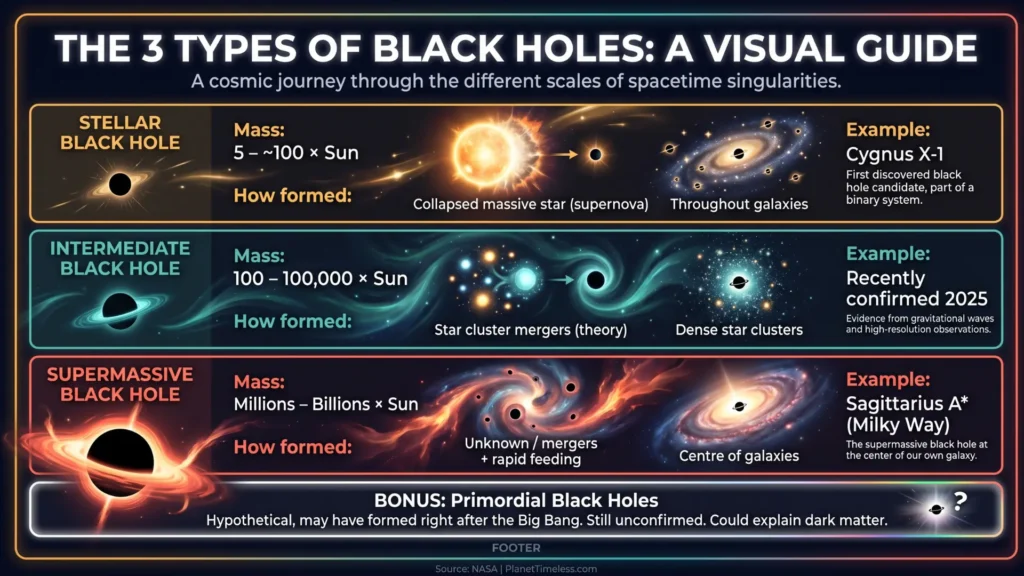
Stellar Black Holes are the most common and are scattered throughout galaxies. The Milky Way alone is estimated to contain millions of them, though only a handful have been definitively identified — they are, by nature, dark and difficult to spot.
Intermediate Black Holes are a relatively recent discovery. For decades, astronomers found only stellar and supermassive black holes, leaving a frustrating gap in the middle. In 2025, a series of studies confirmed growing evidence for this “missing link” category, with masses between 100 and 100,000 solar masses. They may represent the seeds from which supermassive black holes eventually grew.
Supermassive Black Holes are found at the centres of virtually every large galaxy we have examined. Their exact formation mechanism remains debated, and JWST’s discovery of early-universe supermassive black holes — existing less than 600 million years after the Big Bang — has thrown our existing theories into serious question.
Hawking Radiation: Do Black Holes Eventually Die?
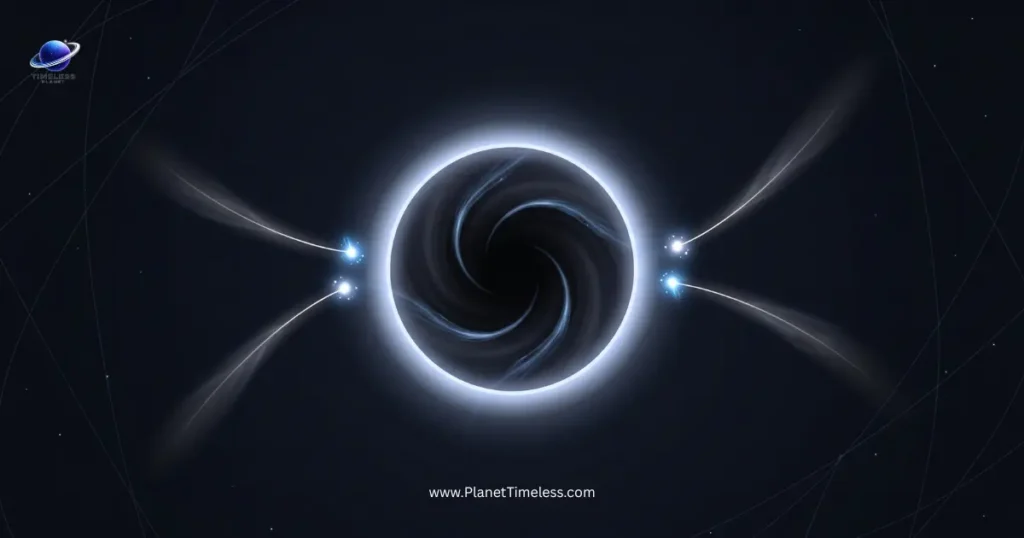
In 1974, physicist Stephen Hawking proposed something that shocked the scientific world: black holes are not perfectly black. Due to quantum effects just outside the event horizon, black holes slowly leak energy in the form of what is now called Hawking radiation. Over an almost unimaginably long timescale — far longer than the current age of the universe for any stellar or supermassive black hole — a black hole could theoretically radiate away all its mass and evaporate entirely.
This prediction has never been directly observed — Hawking radiation from real black holes is far too faint to detect with current technology. But it is one of the most celebrated theoretical results in all of physics because it sits at the junction of two ideas that otherwise refuse to cooperate: Einstein’s general relativity (which governs the very large) and quantum mechanics (which governs the very small). A working theory of black hole evaporation may be our best clue toward a unified “theory of everything.”
The Information Paradox: Physics’ Greatest Unsolved Puzzle
Hawking radiation raises a deeply troubling question: if a black hole evaporates completely and is gone, what happens to all the information about everything that ever fell into it? In quantum mechanics, information cannot simply be destroyed — that would break one of the most fundamental laws of physics. Yet Hawking’s radiation appears to be random, carrying no trace of what the black hole consumed.
This is the famous black hole information paradox, and it remains unsolved. Some of the greatest minds in theoretical physics — including Stephen Hawking himself, who changed his own position on it multiple times — have wrestled with this question. The answer, when it comes, may reshape our entire understanding of space, time, and reality.
What Scientists Discovered About Black Holes in 2025
The pace of discovery in recent years has been remarkable:
- Oldest known black hole confirmed — In 2025, astronomers confirmed CAPERS-LRD-z9 as the oldest known black hole, with a mass of 38 million suns and formed within 500 million years of the Big Bang. Its rapid growth challenges every current model of early-universe black hole formation.
- Largest black hole merger ever recorded — A collision between two black holes each more than 100 times the mass of the Sun produced a resulting black hole of around 225 solar masses — a size that standard stellar collapse cannot easily explain, suggesting these black holes grew through previous mergers.
- Milky Way’s black hole spin measured — Using AI to analyse over 12 million simulations, astronomers determined that Sagittarius A* is spinning near its maximum possible rate, a finding that reveals new information about its history and the extreme physics near its event horizon.
- JWST confirms runaway supermassive black hole — The James Webb Space Telescope confirmed the existence of a supermassive black hole rocketing through its host galaxy at 2.2 million miles per hour, likely ejected after a collision between two galaxies.
For more on how JWST is reshaping our view of the universe, read our full guide to the James Webb Space Telescope’s biggest discoveries.
Why Scientists Are Truly Obsessed
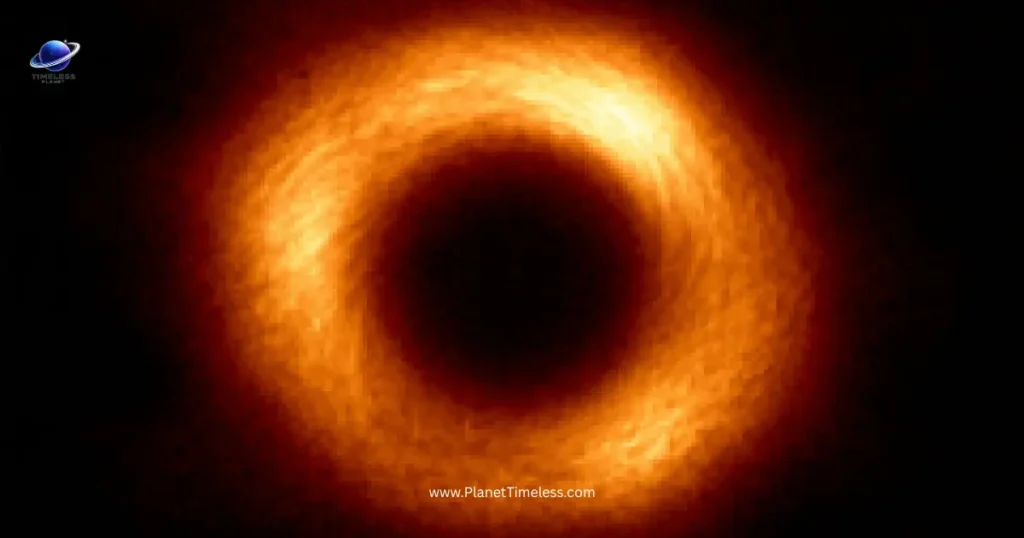
Black holes are not just spectacular objects — they are the universe’s most powerful laboratories. Every major open question in fundamental physics intersects with them. They are where gravity becomes so extreme that Einstein’s equations break down. They are where quantum mechanics and general relativity are forced into an uncomfortable confrontation. They may hold the key to understanding dark matter, dark energy, the information paradox, and the very earliest moments of the universe.
Every discovery — every merger detected by gravitational wave observatories, every image captured by the Event Horizon Telescope, every early black hole spotted by JWST — is a brick in the foundation of a theory that does not yet exist but that scientists can feel getting closer.
There is also something deeply human about the obsession. Black holes are a place where our knowledge ends. And for scientists, that is not terrifying — it is an invitation.
FAQ: Black Holes Explained
-
What exactly is a black hole in simple terms?
A black hole is a region of space where gravity is so powerful that nothing — not even light — can escape. It forms when a massive amount of matter is packed into an extremely small space, creating an escape velocity greater than the speed of light. The boundary of this region is called the event horizon.
-
Can a black hole destroy Earth or our solar system?
No. There is no black hole close enough to pose any threat to Earth. The nearest known black hole is thousands of light-years away. Black holes do not “suck” material in the way a vacuum cleaner does — they only affect objects that come within their gravitational reach, just like any other massive object. If our Sun were magically replaced by a black hole of the same mass, Earth would continue orbiting exactly as it does now, just in darkness.
-
What happens if you fall into a black hole?
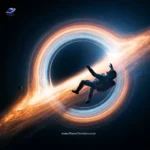
It depends on the size. Near a small stellar black hole, the difference in gravitational pull between your head and your feet would be so extreme that you would be stretched like spaghetti — a process physicists call “spaghettification” — long before reaching the event horizon. Near a supermassive black hole, you could actually cross the event horizon without feeling anything unusual. You would have no way of knowing you had crossed it. What happens after that — inside — is unknown. Our physics cannot currently describe it.
-
What is Hawking radiation and has it been detected?
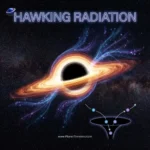
Hawking radiation is a theoretical prediction by Stephen Hawking that black holes slowly emit energy due to quantum effects near the event horizon, causing them to very gradually lose mass over astronomical timescales. It has not been directly detected from an actual black hole — it is far too faint for current instruments — but it is supported by strong theoretical reasoning and has been replicated in laboratory analogues using sound waves in flowing fluids.
-
How big is the black hole at the centre of the Milky Way?
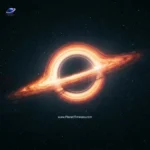
Sagittarius A*, the supermassive black hole at the centre of our galaxy, has a mass of approximately 4 million times that of the Sun. Its event horizon has a radius of about 12 million kilometres — roughly 17 times the radius of the Sun. In 2022, the Event Horizon Telescope collaboration released the first direct image of Sagittarius A, confirming its existence beyond any doubt.
Conclusion: The Universe’s Greatest Mystery, Hiding in Plain Sight
Black holes began as a mathematical curiosity in Einstein’s equations — an extreme solution that many physicists, including Einstein himself, assumed nature would never actually produce. Today we know they exist in their billions across the cosmos, that one sits at the heart of virtually every large galaxy including our own, and that their behaviour continues to challenge and stretch our deepest theories of reality.
They form when massive stars die, grow by consuming gas and merging with each other, and may one day — over timescales longer than the current age of the universe — evaporate entirely into a faint hiss of radiation. Everything in between remains gloriously, productively mysterious.
What lies inside a black hole? What happens to the information that falls in? How did supermassive black holes grow so quickly in the early universe? These are not just astronomical questions. They are among the deepest questions humans have ever asked, and science is closer than ever to answering them.
The universe hides its most extreme secrets in its darkest places. Black holes are proof that the most interesting things often cannot be seen — only felt, inferred, and slowly, painstakingly understood.
Enjoyed this article? Share it and explore our related deep dives:
1 thought on “Black Holes 101: What They Are, How They Form, and Why Scientists Are Obsessed”